

Auresta Ash Orange Lens Blue Light Glasses
Anti-glare computer and screen glasses — orange lens, nine-layer coating, 19 g TR90. Built for long days at a monitor.
- Orange lens — 99% of blue light across 380–500 nm, lab-tested
- Nine-layer anti-glare coating · UV400
- 19 g TR90 frame
Product Details
Ash — Square Blue Light Glasses in Frosted Grey TR90
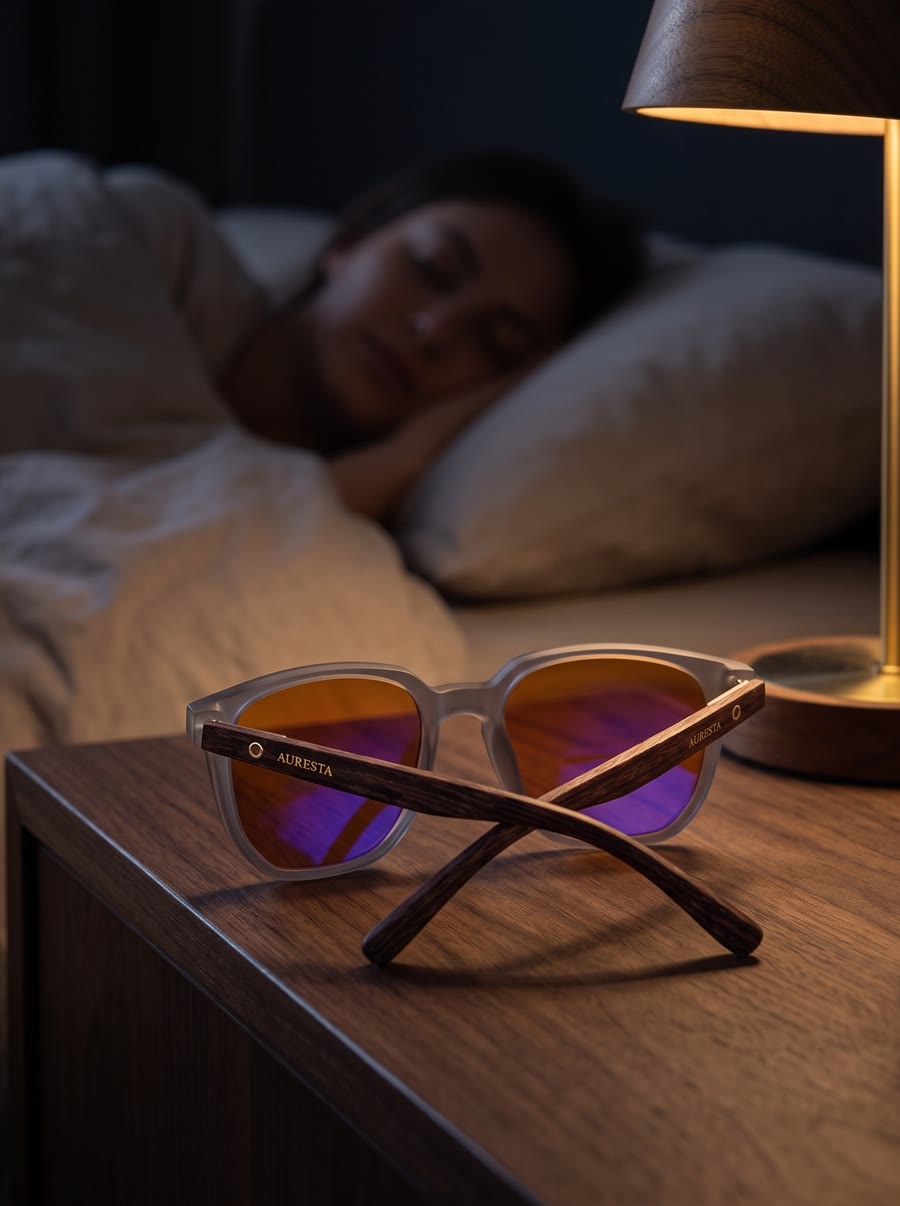
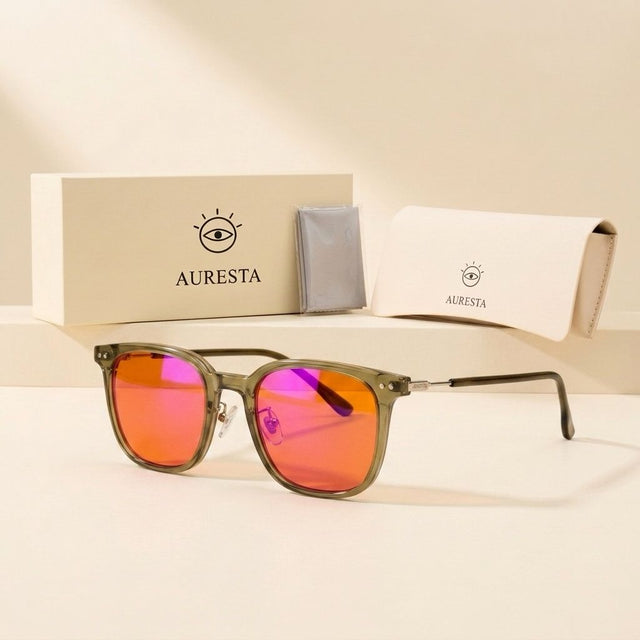
The only Auresta frame that mixes materials: a matte frosted grey TR90 square front and dark wood-finish temples, joined on polished silver hinges with a gold AURESTA wordmark. The frost diffuses light softly instead of reflecting it, and skips the fingerprint-polishing ritual a gloss finish demands. Slim straight temples sit under a gaming headset; at 19 grams you forget the frame long before the last episode ends.
The lens is orange, and openly so. Whites turn warm, blues drop back, and the whole screen moves a few degrees toward evening — that shift is not a side effect, it is the filtering made visible. Nine layers of anti-reflective coating take the reflections your monitor throws back at you out of the picture. The full lens test is published on this page, wavelength by wavelength.
- Frame: Frosted grey square with dark wood-finish temples — TR90 memory polymer, 19 g, bends rather than snapping
- Lens: Orange tint with a nine-layer anti-reflective coating
- Blue light: 99% of blue light across 380–500 nm filtered (1.01% transmitted) — lab-tested to BS EN ISO 12312-1
- UV: UV400 — 0.00% transmittance at 380, 390 and 400 nm
- Filter category: 1 — luminous transmittance (Tv) 47.05%
- Colour cast: whites go golden, blues mute. Take them off for photo editing, video grading and design work
- Not suitable for driving or road use — blue signal light recognition measured 0.34 where the standard requires 0.6 or above
- Included: free UK shipping, and 30 days to wear them and decide
Shipping & Returns
Will it fit me?
One size, medium fit — suits most faces. If it's not right, you're inside the 30-day return window.
Soft Frost, Warm Wood, Orange Lens
The Ash is the only Auresta frame that mixes materials: a frosted grey translucent TR90 square front and dark wood-finish temples, joined on polished silver hinges with a gold AURESTA wordmark. The matte frost shrugs off fingerprints where a gloss finish collects them. Behind it sits the same lens as every Auresta pair: orange, and openly so. Whites turn warm, blues drop back, and the whole screen moves a few degrees toward evening — that shift is not a side effect, it is the filtering made visible. A nine-layer anti-reflective coating handles the rest, so the reflections your monitor throws back at you and the ceiling light sitting in the corner of your vision mostly disappear.
- ◆Orange lens — 99% of blue light across 380–500 nm filtered, lab-tested
- ◆Nine-layer anti-reflective coating — reflections and glare drop out of the picture
- ◆UV400 — 0.00% transmittance at 380, 390 and 400 nm (lab-tested)
- ◆19 g frosted grey square TR90 with wood-finish temples — matte, fingerprint-free, headset-friendly
Ten Hours In
Most glasses announce themselves by hour three — a pinch at the temple, a weight on the bridge, the small constant awareness that something is on your face.
These are 19 grams of TR90 with slim straight arms that pass under a headset cup rather than fighting it. Put the Ash on at nine in the morning and the reason you take them off is that you’re going somewhere, not that they started to hurt.
- ◆Nine-layer coating — reflections and glare drop out of the picture
- ◆19 g TR90 frame — flexible, headset-friendly
- ◆UV400 outdoors as well as indoors — one pair, desk to street
When the Monitor Stops Being a Screen
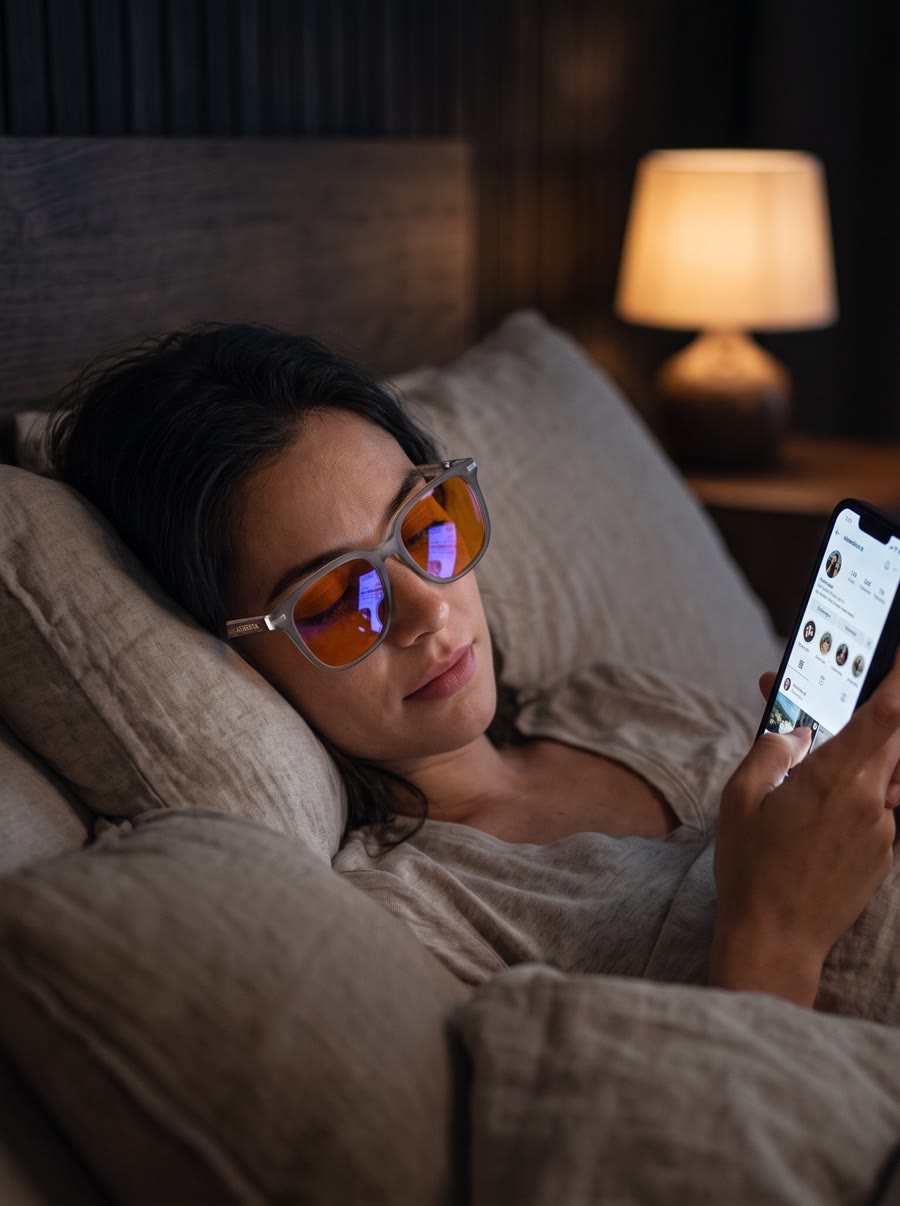
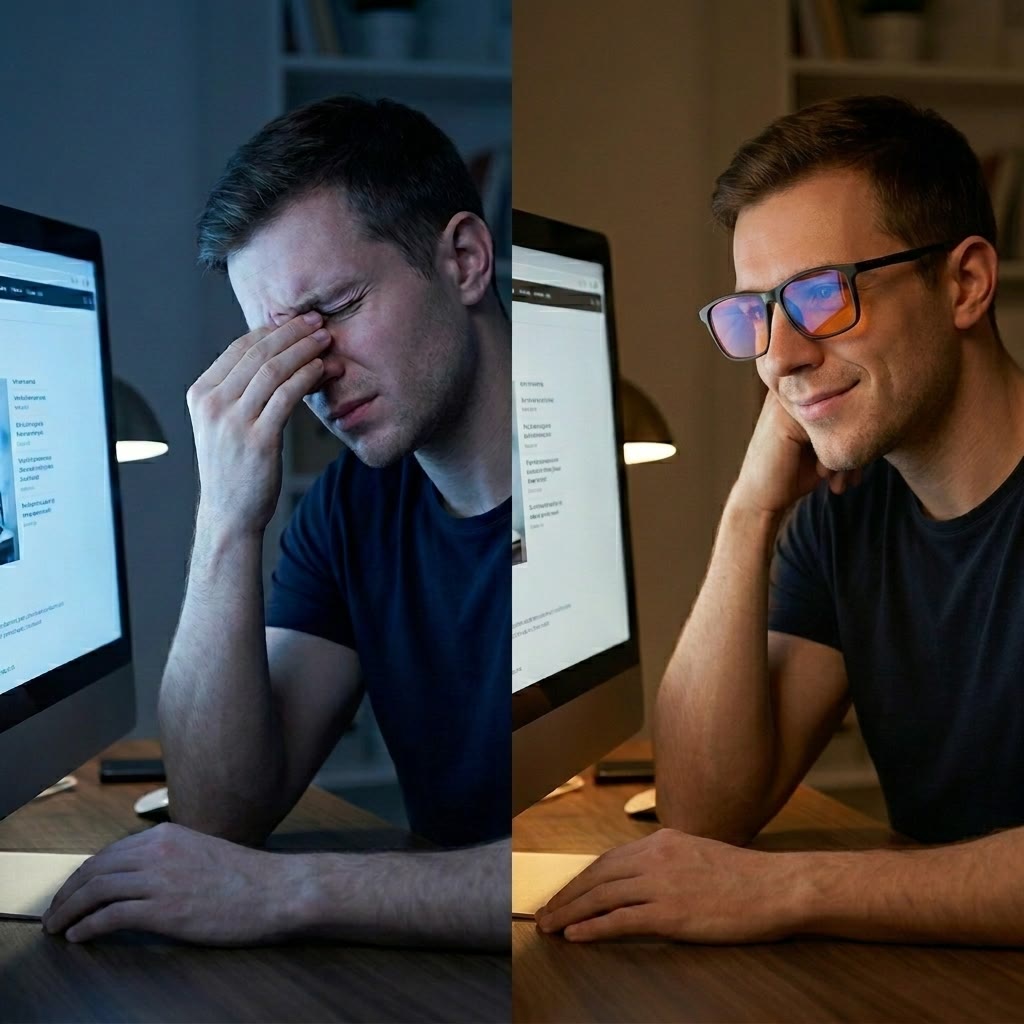
There’s a point in the evening where your monitor stops being a screen and starts being a light in your face. The white of a document goes from paper to floodlight. Every lamp in the room shows up as a smear across the top of the display.
Put these on and that drops out. The reflections go. The white settles into something closer to warm paper. The screen gets quieter.
It’s a filter, not a fix — if you’ve got a window behind your monitor and the brightness at 100%, sort that first. Our digital eye strain guide covers it, and it’s free.
But if you’ve done all that and the screen still feels loud at 9pm: this is what the orange is for.
- ◆The reflections go — nine-layer anti-reflective coating
- ◆White stops being a floodlight — 99% of blue light across 380–500 nm filtered
- ◆A filter, not a fix — and not for driving
Why Choose the Ash Grey Square Blue Light Glasses?
The Ash is the only Auresta frame that mixes materials: a frosted grey translucent TR90 square front and dark wood-finish temples, joined on polished silver hinges under a gold AURESTA wordmark. The lens is unchanged from the rest of the range — orange, filtering 99% of blue light across 380–500 nm, UV400, lab-tested to BS EN ISO 12312-1.
The frosted front is the detail people notice second and appreciate longest, because matte grey does not collect the fingerprints that a gloss frame turns into a daily polishing ritual. What you accept, as with every orange lens, is a warm cast across everything you look at, no colour-critical work while wearing them, and no driving. Delivery is free across the UK in 2–4 business days, with thirty days to return them.
Frosted Grey, Wood-Finish Temples
A matte translucent TR90 square front paired with dark wood-finish arms on polished silver hinges. About 19 grams, and the frost means it looks the same at the end of a working week as at the start.
The Measured Orange Lens
Under 0.5% transmittance across the 415–455 nm peak, 99% of blue light across 380–500 nm filtered overall, 0.00% at 380, 390 and 400 nm, category 1 at 47.05% luminous transmittance.
Straight Arms, Long Sessions
The temples run straight and slim enough to pass under a headset cup, and the nine-layer coating keeps your own monitor from reflecting back off the inside face of the lens after dark.
Questions About the Ash
Are the Ash temples real wood?
They are a wood finish, not solid timber — the arms are polymer with a dark wood grain, chosen because real wood at this length either adds weight or splits at the hinge. The look is wood; the flex and the 19 grams are TR90.
Why choose a frosted frame over a glossy one?
Two reasons, one of them practical. Matte grey diffuses light instead of throwing highlights, so the frame stays quiet on video calls and in photographs, and it does not hold fingerprints the way gloss does — you stop noticing the frame, which is the point.
Is the square shape too wide for a smaller face?
The Ash sits mid-width in the range rather than oversized. If you have worn a square frame comfortably before, this one will fit; if you are unsure, the eye-bridge-temple measurements are listed in the fit guide further up the page.
What Changes When You Put Them On
Five things the Ash actually does — every one of them backed by the lab numbers further down this page.

We Measured the Lens. Here Are the Numbers.
Most blue light glasses ask you to take their word for it. Ours went through a spectrometer, wavelength by wavelength, against BS EN ISO 12312-1:2013+A1:2015 — the European standard for eye filters. This is exactly what came back.
| Wavelength | Light passing through | Band |
|---|---|---|
| 380 nm | 0.00% | UV cut-off |
| 400 nm | 0.00% | UV / blue edge |
| 410 nm | 0.27% | Bluepeak HEV |
| 420 nm | 0.38% | Bluepeak HEV |
| 430 nm | 0.48% | Bluepeak HEV |
| 440 nm | 0.41% | Bluepeak HEV |
| 450 nm | 0.31% | Bluepeak HEV |
| 460 nm | 0.90% | Blue |
| 480 nm | 2.15% | Blue |
| 500 nm | 6.27% | Blue-green |
| 520 nm | 10.90% | Green |
| 550 nm | 41.14% | Green |
| 580 nm | 74.67% | Yellow |
| 620 nm | 86.89% | Orange |
| 700 nm | 90.39% | Red |
| 780 nm | 89.46% | Deep red |
Across the 415–455 nm band — where blue light peaks — under 0.5% gets through. UV400: 0.00% transmittance at 380, 390 and 400 nm. The trade-off is deliberate and visible: a lens that stops this much blue light is a warm orange tint, not a clear one.
Source: lens test report from our lens manufacturer — not an independent or third-party laboratory — measured on a Topcon sigm tm-3 spectrometer to BS EN ISO 12312-1:2013+A1:2015 (280–780 nm). Figures apply to the orange blue-light lens used across the Auresta eyewear range. The lens was tested against that standard but does not meet all of its criteria: blue signal light recognition measured 0.34 where 0.6 or above is required, which is exactly what filtering this much blue costs you — not suitable for driving or road use.
Same Lens. Different Frame.
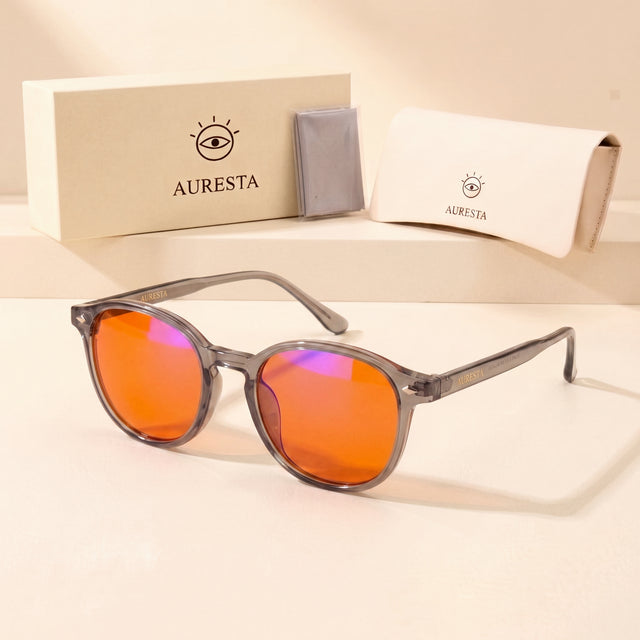
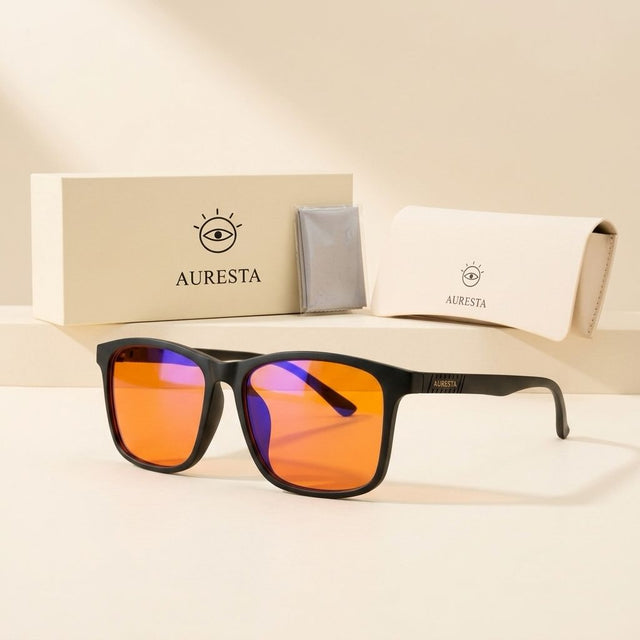
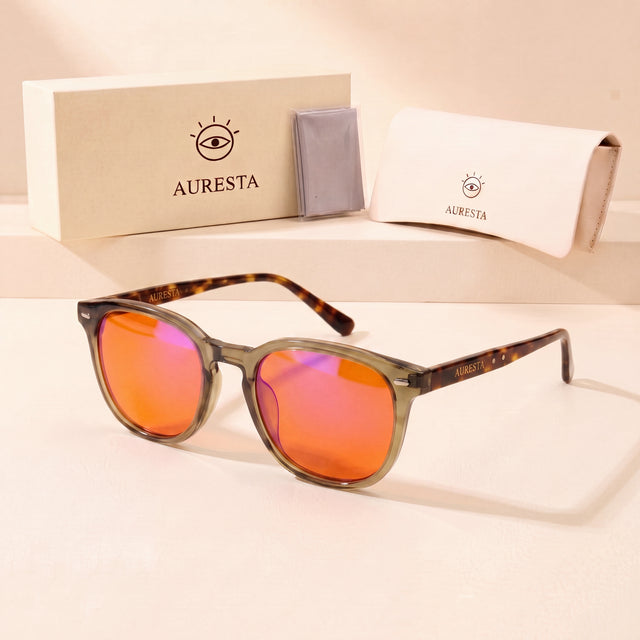
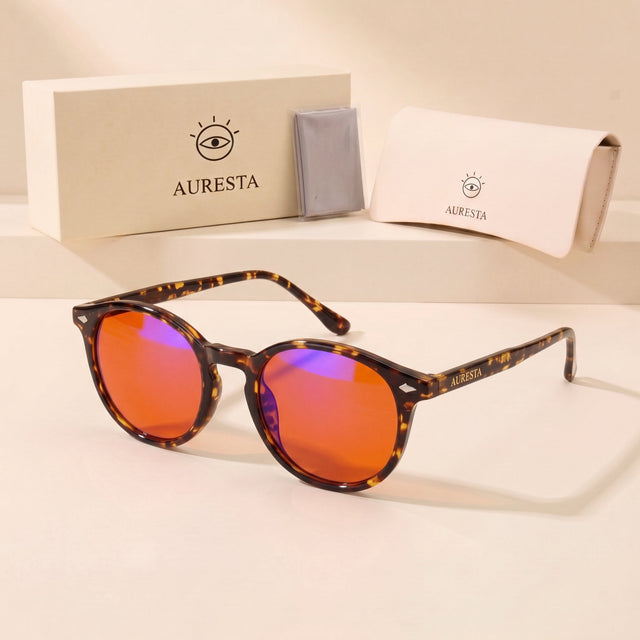
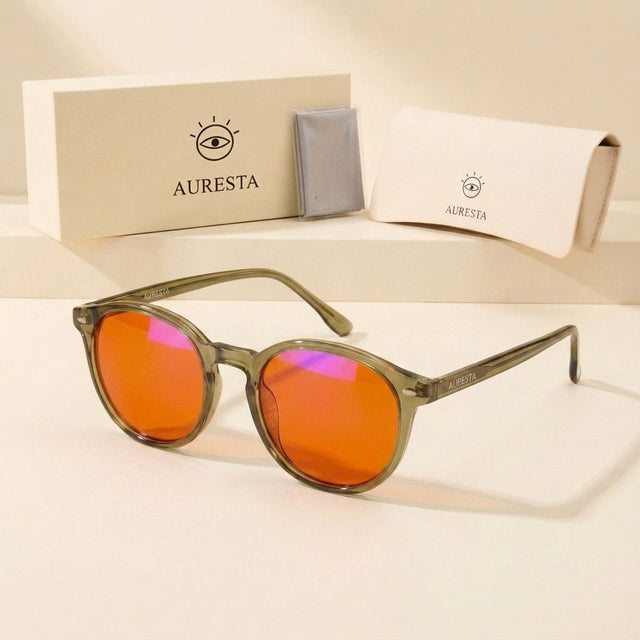
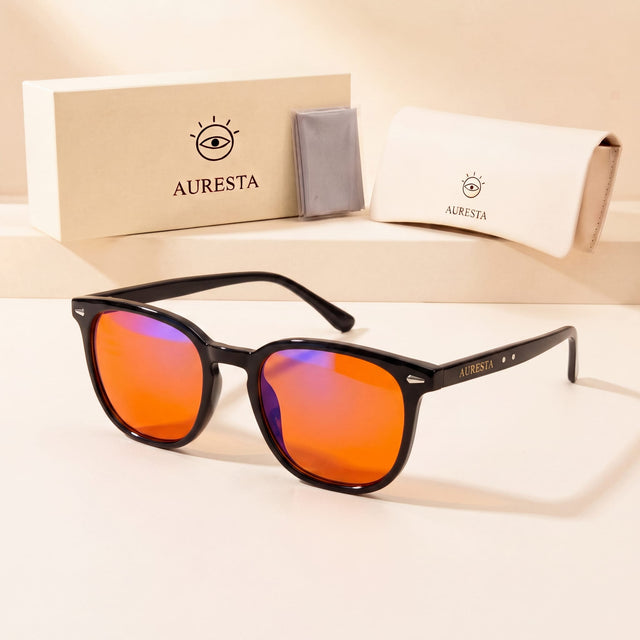
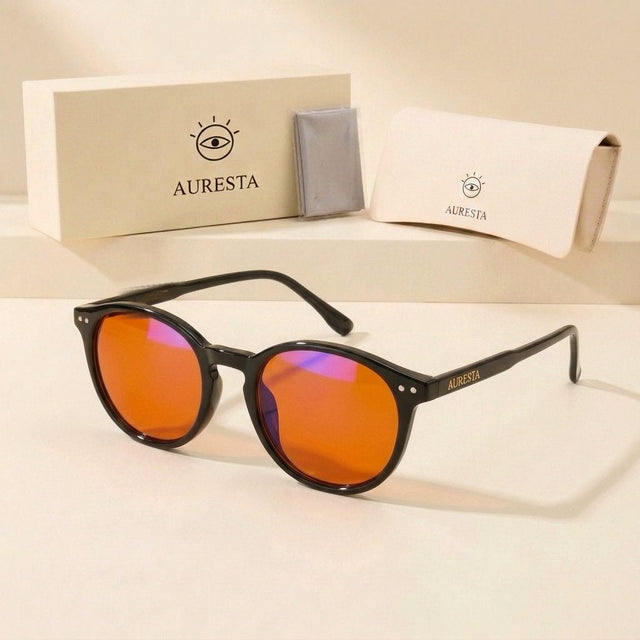
Every Auresta frame uses the identical orange lens you just read the numbers for. Pick the shape you want to wear.
-
 Auresta
£49.99
Auresta
£49.99 -
 Auresta
£49.99
Auresta
£49.99 -
 Auresta
£49.99
Auresta
£49.99 -
 Auresta
£49.99
Auresta
£49.99 -
 Auresta
£49.99
Auresta
£49.99 -
 Auresta
£49.99
Auresta
£49.99 -
 Auresta
£49.99
Auresta
£49.99 -
 Auresta
£49.99
Auresta
£49.99
Before You Buy, Read the Science
Auresta vs GUNNAR Gaming glasses: Which Should You Choose?
Auresta vs GUNNAR Gaming Glasses: Which Is Right for You? When gamers and screen-heavy professionals compare b…
Read the guideAuresta Glasses Frames Comparison: Which Model Is Right for You?
When comparing Auresta glasses frames, you are comparing eight shapes wrapped around one identical lens. Ember…
Read the guideBlue Light Glasses for Sleep: Do They Actually Work?
Blue Light Glasses for Sleep: Evidence-Based Guide to Better Rest Blue light glasses for sleep are designed to…
Read the guideWorking From Home Eye Strain: A Practical Guide for Long Screen Days
Working from home eye strain is real, common and mostly self-inflicted — not by you, but by setups and habits…
Read the guideCan You Wear Blue Light Glasses All Day?
Yes — you can safely wear blue light glasses all day . One hard exception: this is a Category 1 orange tint an…
Read the guideDo Blue Light Glasses Help With Headaches? An Honest Answer
For some people, yes — blue light glasses can help with headaches caused by long screen sessions , mainly by s…
Read the guideBlue Light Glasses for Sleep and Gaming: What You Actually Need to Know
Blue light glasses designed for sleep and gaming work by filtering the high-energy wavelengths that screens em…
Read the guideAuresta Blue Light Glasses FAQ: Every Question Answered
This Auresta blue light glasses FAQ answers the questions we get most often about our orange-lens eyewear — wh…
Read the guide5 Signs You Have Digital Eye Strain (and How to Fix It)
If your eyes feel tired, dry or achy after a day at the screen, you're not imagining it. Digital eye strain (a…
Read the guideAmber vs Clear Lenses: Which Gaming Glasses Are Right for You?
If you've started shopping for gaming glasses, you've probably run into the big question right away: should yo…
Read the guideWhat you’re actually buying
An orange lens, nine layers of coating on it, 19 grams of TR90 around it, and the spectrometer readout printed where you can check it.
- A lens with a colour to it. Orange, and openly so. Whites turn warm, blues drop back, the whole screen moves a few degrees toward evening. That shift isn’t a side effect — it’s the filtering, made visible.
- Nine layers of anti-reflective coating. The reflections your monitor throws back at you, and the ceiling light sitting in the top corner of your vision all day, mostly disappear. This is the part you notice in the first ten seconds.
- UV blocked to zero where it counts. 0.00% transmittance at 380, 390 and 400 nm. The same pair works walking home in the sun.
- 19 grams of TR90. Flexible frame, slim arms that slide under a headset instead of pressing into it.
- And the honest part: the full lens test is published on this page, wavelength by wavelength. Almost nobody in this category does that. Read it before you buy, not after.
Frequently asked questions
Everything you need to know about Auresta orange-lens blue light glasses — what the tint does, what it costs you, the TR90 frame, shipping and returns.
Are amber lenses better than clear ones?
For filtering blue light, yes, and it is not close. A clear lens with a coating reflects a modest share of the blue band. An amber — properly, orange — lens absorbs it, and the lens reads orange precisely because the blue is not getting through. Even the optometrists who dismiss clear blue-light lenses accept that a genuine tint does something. The cost is a warm cast to what you see.
Will the amber lenses change how I see colours?
Yes, a little — whites lean golden and blues are muted, and that shift is exactly what the filtering looks like. Most people stop noticing within a few minutes. If you do colour-critical work, photo editing or grading, take them off for it.
Are these good for gaming and long screen sessions?
For the long session, yes — that is what they are built for. The orange tint and the nine-layer anti-reflective coating take the reflections off your monitor and the lights behind it out of the picture, and the 19 g TR90 frame has slim straight arms that pass under a headset cup instead of fighting it. If you play competitively and read colour cues to win, do not buy these: an orange lens takes colour information away. We would rather tell you than take the money and get the pair back.
What about sleep — do these do anything?
We are not going to promise you anything about your sleep, because the evidence does not let us. Here is what exists: Cochrane calls the sleep evidence indeterminate, and a small 2009 trial (Burkhart & Phelps) on amber lenses worn before bed is the most-cited study in the category. What we can describe is what changes in the room: put them on at 10pm and the screen goes the colour of a lamp. Whether that is worth it to you is your call, and you have thirty days to make it.
Do they work outdoors as well as at a desk?
Yes. UV400 — 0.00% transmittance at 380, 390 and 400 nm (lab-tested). The same pair works walking home in the sun. Not for driving, though: this is a Category 1 orange tint and it does not meet the blue signal-light recognition requirement of the standard it was tested to.
Can I drive in them?
No. Tested against BS EN ISO 12312-1, the lens scored 0.34 on blue signal light recognition where the standard asks for 0.6 or above. That is a direct consequence of how much blue it filters. Day or night, take them off before you pick up the keys.
Do Auresta blue light glasses actually work?
Yes — and here is exactly what “work” means. An orange lens absorbs blue light in the 400–500 nm band rather than reflecting a small share of it the way a clear lens does. That raises contrast, cuts the reflections your monitor and the ceiling light throw back at you, and takes the harsh edge off a bright screen. That is what you feel in the first ten seconds, and the full lens test is published on this page, wavelength by wavelength. On eye strain specifically the evidence is mixed: the 2023 Cochrane review of 17 randomised trials found blue-light-filtering lenses probably make no measurable difference, and the College of Optometrists says the same. We would rather tell you that than sell you a promise.
How much is shipping and how fast is delivery?
Shipping is free on every order, with delivery in 2–4 business days.
What is your returns policy?
Thirty days. Not thirty days in the box — actually wear them, at your desk, at 10pm, for a week. If the orange isn’t for you, or you just don’t like them on your face, send them back for a full refund. Normal wear is expected. We only ask the frame and lens come back undamaged, in the case. This sits on top of your statutory 14-day right to cancel.
What are the frames made of?
TR90 — a flexible memory polymer used in sports and performance eyewear. Nineteen grams, and it bends rather than snapping.
How to Choose Your Gaming Glasses
Screen glasses are sold on a lot of promises the evidence does not support. Here is what the Ash actually does, and what it does not.
An orange tint, not a clear lens
A clear lens with a coating reflects a modest share of blue light. The Ash's lens absorbs it — the lens reads orange precisely because under 0.5% of the 415–455 nm band is getting through. That is the whole difference, and it is why the tint is visible.
Glare and contrast, which you will feel
A nine-layer anti-reflective coating cuts the reflections thrown back at you by your monitor and the lights behind it. Less glare means more contrast and less squinting through a long session — this is the part of the product with an obvious, immediate effect.
Where the evidence is strongest
The clearest science in this category is about evenings: blue light in the hours before bed delays melatonin, and amber is the tint with actual trials behind it. Daytime eye strain is a different story — the 2023 Cochrane review found filtering alone probably doesn't fix tired eyes, so we don't sell that. What you'll feel by day is the glare and contrast difference; what you're buying for is the evening.
Evenings, and honest limits
Blue light in the hours before bed delays melatonin, and amber is the tint with trials behind it — though Cochrane still calls the overall sleep evidence indeterminate. Wear them before bed and judge for yourself. Do not wear them, or any tint, for night driving.
Comfort you can verify
Frosted TR90 front, about 19 g, with slim straight wood-finish temples that sit under a headset instead of digging in. The matte frost also skips the fingerprint-polishing ritual gloss frames demand. Weight is not a marketing claim — you will notice it by hour six.
For the long session, not the ranked ladder
If you're playing story-driven, single-player, or anything at 1am, the Ash is built for exactly that — the arms sit under a headset and the glare from your monitor stops bouncing back at you. If you play competitively and read colour cues to win, don't buy these. An orange lens takes colour information away. We'd rather tell you than take the money and get the pair back.
Reviews coming in
We give a 20% code for leaving a review — and the code lands whatever you write. One star, five stars, same code. We don’t filter, edit or delete reviews by rating. Every review is checked before it appears, and buyers we can match to an order are labelled as verified.
We're new, so there aren't many yet.
A brand that only rewards the good ones ends up with a wall of five stars nobody believes. We'd rather have thirty honest reviews than three hundred bought ones — so the 20% code lands whatever you write, and nothing here is invented.