
Amber Lens Blue Light Glasses
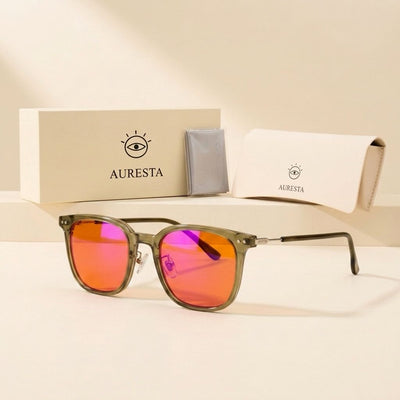
Every Auresta lens is amber, and that is a deliberate choice rather than a styling one. A clear lens with a blue-light coating reflects part of the 400–500 nm band. An amber lens absorbs it. The lens looks orange precisely because the blue is not coming through.
The trade-off is honest and worth stating: whites lean warm and blues are muted. In exchange you get a visibly calmer screen: the reflections drop out and the white of a document settles into something closer to warm paper. We do not claim more than that, because the evidence does not support more than that.
Every frame uses the same lens — 99% of blue light across 380–500 nm filtered, nine-layer coating, and UV400 at 0.00% transmittance for 380, 390 and 400 nm — in a 19 g TR90 frame. Not for driving.
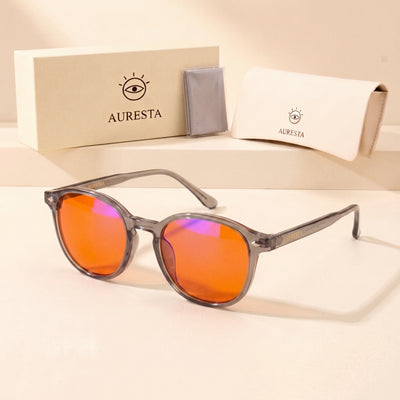
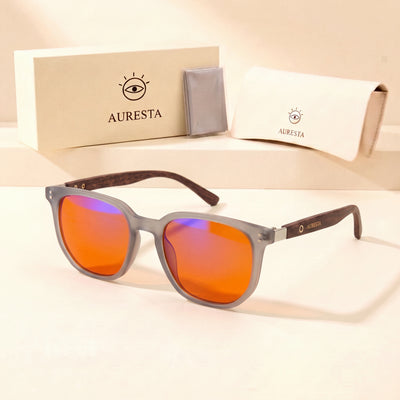
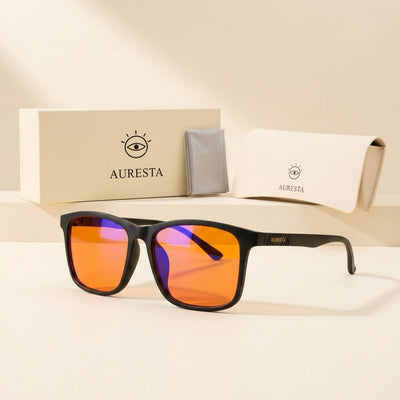
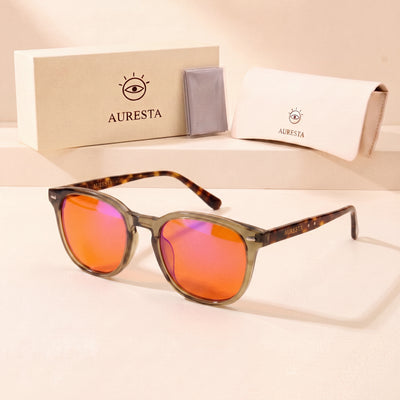
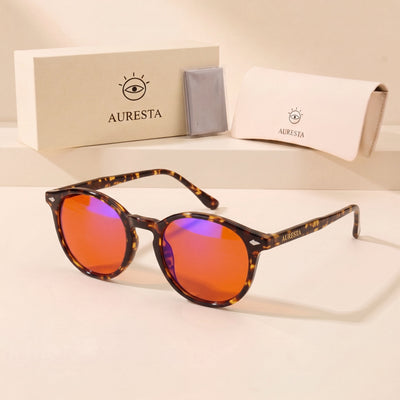
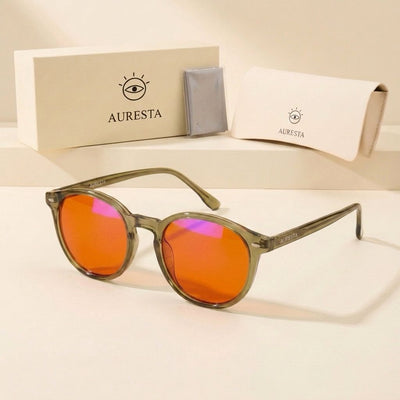
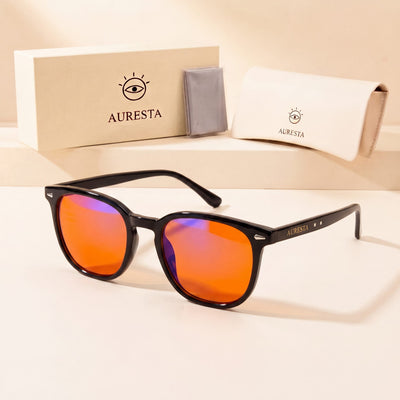
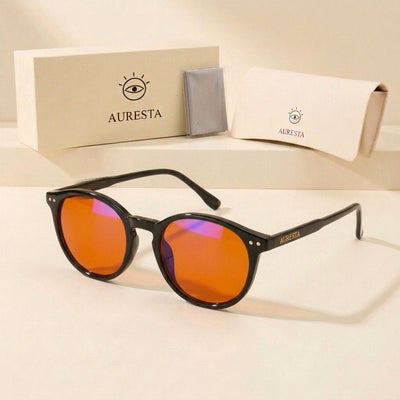
Why Choose an Amber Lens Over a Clear One?
Amber is a physics decision before it is a styling one. A lens has two ways to deal with blue light: reflect a slice of it off a surface coating, or absorb it in the lens material. Absorption is what turns a lens orange, and it is the reason ours is. Measured on a spectrometer against BS EN ISO 12312-1, the Auresta lens filters 99% of blue light across 380–500 nm, transmits 1.01%, and lets under 0.5% through the 415–455 nm band where screen output peaks.
On a desk that looks like this: a white document settles into something closer to warm paper, and the cold edge comes off a bright monitor. What it costs is colour judgement. Blues are muted and whites lean golden, so photo editing, design and anything graded should be done with the glasses off. The tint is filter category 1 at 47.05% luminous transmittance — light enough to work under all day, and far too tinted to drive in, at any hour.
Everything behind the tint is shared across the range: a nine-layer anti-reflective coating, UV400 at 0.00% transmittance for 380, 390 and 400 nm, a TR90 frame at about 19 grams, non-prescription plano lenses, £49.99, free UK delivery in 2–4 business days and thirty days to change your mind. The Vesper adds a blue-mirror finish on the outer face, which changes what other people see rather than what you do.
Absorption Beats a Coating
A blue-light coating on a clear lens reflects part of the band; an amber lens absorbs it. That is the whole difference, and it is visible: the depth of the orange is the depth of the filtering, which is why our lens does not pretend to be clear.
What the Tint Costs You
Whites go warm, blues drop back, and most people stop noticing inside a few minutes. It is still a real loss of colour information, so anything colour-critical — grading, print work, matching a shade on screen — belongs to your bare eyes.
The Same Lens in Every Frame
Shape and colour are the only decisions on this page. Square, round and panto fronts all carry identical optics, identical coating and identical measured figures, so choosing a frame you would actually wear costs you nothing in filtering.
Straight answers
Are amber lenses better than clear for blue light?
For filtering blue light, yes — and it is not close. A clear lens with a blue-light coating reflects a modest share of the 400–500 nm band. An amber lens absorbs it, which is why the lens looks amber: the blue is not getting through. The cost is a warm cast to what you see, which is why clear lenses still exist.
What are orange lens glasses for?
Two jobs. Screens: absorbing blue light raises contrast and takes the harshness out of a bright monitor. Evenings: put them on at 10pm and the room turns the colour of a lamp. On whether that does anything for your sleep, Cochrane calls the evidence indeterminate, and so do we.
Will amber lenses change how I see colours?
Yes, a little. Whites lean golden and blues are muted. Most people stop noticing within a few minutes, but if you do colour-critical work — photo editing, design, grading — you should take them off for it.
Do amber lenses help you sleep?
We are not going to promise you that. It is the most-studied claim in the category and it is still thin: a small 2009 trial (Burkhart & Phelps) is the one everyone cites, and Cochrane calls the overall evidence indeterminate. What we can describe is what changes in the room — the screen goes the colour of a lamp. Whether that is worth it to you is your call, and you have thirty days to make it.
Are amber lenses good for computer work?
For glare and contrast, yes. For eye strain, be sceptical — the 2023 Cochrane review found no reliable benefit from blue-light-filtering lenses on eye-strain symptoms. Anyone telling you an amber lens cures tired eyes is ahead of the evidence.