
Blue Light Glasses
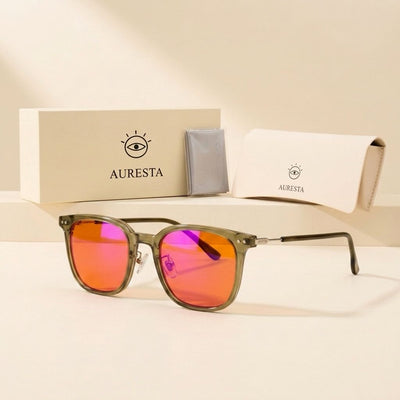
Every Auresta frame is a blue light glass with a warm amber lens rather than a clear one — because a clear lens reflects a little blue light, while an amber lens absorbs a lot of it. The tint filters the 400–500 nm band that monitors, phones and LED lighting push out hardest, lifts contrast and takes the harsh edge off a bright screen.
Every frame shares the same optics: a nine-layer anti-reflective coating, UV400 — 0.00% transmittance at 380, 390 and 400 nm — and a 19 g TR90 memory-polymer build that bends rather than snapping. They differ only in shape and colour, so pick the one you would actually wear.
We will not tell you blue light glasses fix tired eyes — the evidence does not support that, and we would rather say so. What an orange lens does is take the reflections and the harsh white out of the picture. The cost is a warm colour cast, and a tint you must not drive in.
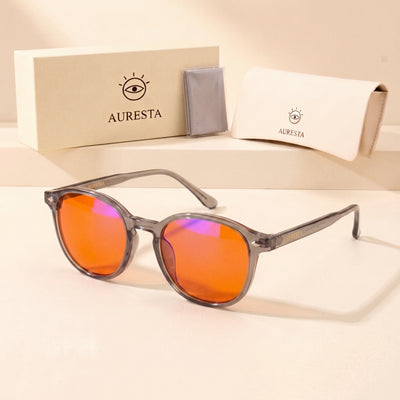
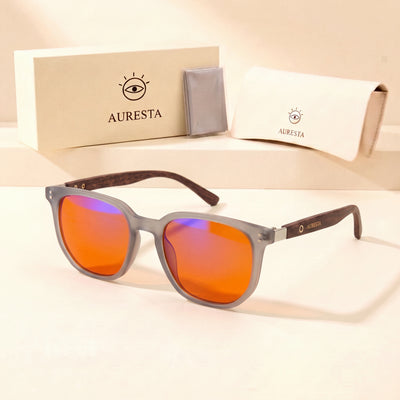
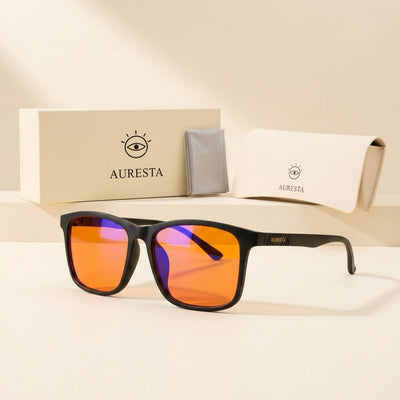
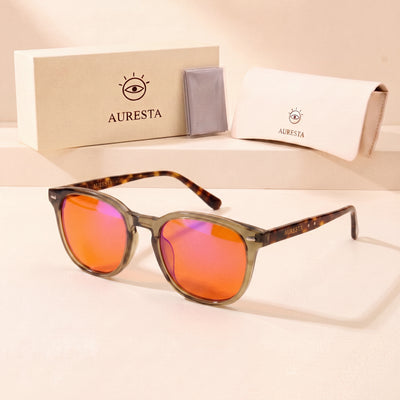
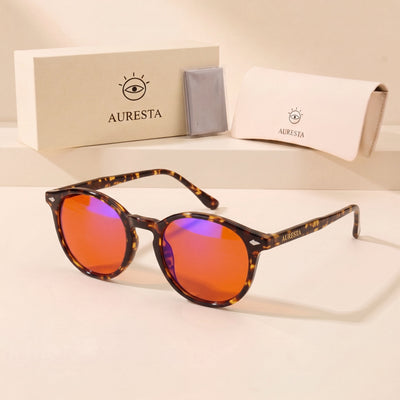
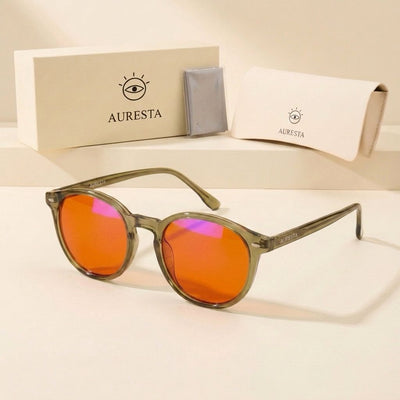
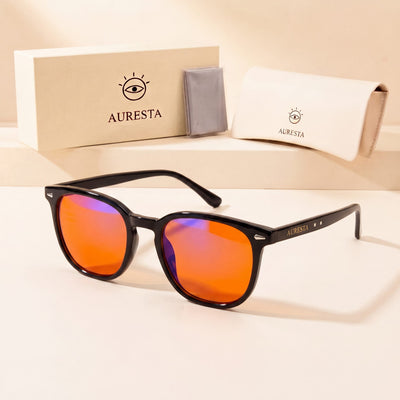
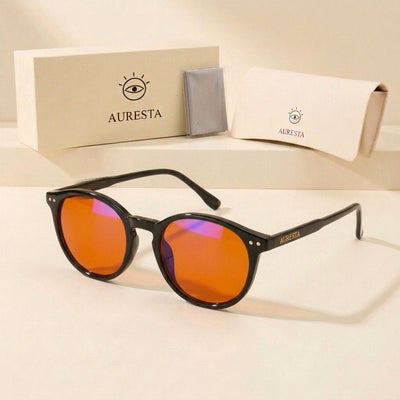
Why Choose Auresta Blue Light Glasses?
Most blue light glasses sold in the UK use a clear lens with a coating on the front, and a coating can only reflect a modest slice of the blue band back off the surface. Auresta uses an orange lens that absorbs it instead: 99% of blue light across 380–500 nm filtered, 1.01% transmitted, and under 0.5% getting through the 415–455 nm stretch where a monitor pushes hardest. Those are spectrometer readings taken wavelength by wavelength against BS EN ISO 12312-1, and the full table is printed on every product page.
The rest of the pair is deliberately plain. A TR90 memory-polymer frame at about 19 grams, slim temple arms, a nine-layer anti-reflective coating that keeps the room behind you off the lens, and UV400 measured at 0.00% transmittance for 380, 390 and 400 nm. One price across the range at £49.99, free UK delivery in 2–4 business days, and every pair non-prescription plano — no eye test, nothing to specify at checkout.
The trade-off is colour, and you should hear it here rather than after the parcel arrives. An orange lens warms whites and pushes blues back; that shift is the filtering made visible, so take them off for anything where colour decides the outcome. And do not drive in them at any hour: tested to BS EN ISO 12312-1, the lens scored 0.34 on blue signal light recognition where the standard asks for 0.6 or above. You have thirty days to send a pair back, return postage covered.
Absorbed, Not Reflected
A clear lens with a blue-light coating bounces part of the band off the front surface. An orange lens takes it out of the picture — 99% of blue light across 380–500 nm filtered, 1.01% transmitted. The lens looks amber precisely because the blue is not coming through it.
Numbers Off a Spectrometer
UV400 at 0.00% transmittance for 380, 390 and 400 nm, filter category 1 at 47.05% luminous transmittance, under 0.5% across the 415–455 nm blue peak. Measured to BS EN ISO 12312-1 rather than estimated, and published in full on each frame’s page.
19 Grams of TR90
A memory polymer that bends back rather than snapping, at roughly 19 grams, on slim straight temples that pass under a headset cushion. Plano lenses throughout, so they sit over contact lenses or over nothing at all.
Straight answers
Do blue light glasses actually work?
Honestly: it depends what you want them to do. The 2023 Cochrane review of 17 randomised trials found blue-light-filtering lenses may not reduce eye strain from computer use, and we are not going to tell you otherwise. What amber lenses like ours demonstrably do is filter blue light in the 400–500 nm range, raise contrast and cut glare on a bright screen, and take the reflections and glare off a bright screen. On sleep, Cochrane calls the evidence indeterminate — we are not going to promise you anything there.
What colour lens blocks the most blue light?
Tint depth is what matters, not marketing. A clear lens with a coating reflects a small share of blue light. An amber or orange lens absorbs far more of it, which is why every Auresta frame uses a warm amber tint rather than a clear one. The trade-off is a mild warm cast to what you see.
Are blue light glasses worth it if I only use screens during the day?
For daytime work the honest case is glare and contrast, not a cure for tired eyes. If your screen sits under bright office lighting or by a window, an amber lens noticeably calms the picture. If your evenings are screen-heavy, the sleep argument is the stronger one.
Can I wear blue light glasses all day?
Yes. There is no evidence that wearing a blue-light-filtering lens all day is harmful. Ours are non-prescription and weigh about 19 g, which is the point of a TR90 frame this light. One hard exception: this is a Category 1 orange tint and you must not drive in it, day or night.
Can I wear these for night driving?
No — and not in daylight either. Tested against BS EN ISO 12312-1, the lens scored 0.34 on blue signal light recognition where the standard asks for 0.6 or above. Keep them for screens and walking about.
Do they come with a prescription?
No. Every Auresta frame ships non-prescription (plano). Your optician can fit prescription lenses into the frame if you want them.