
Gaming Glasses
A gaming glass earns its keep in two places: the tint and the coating. Auresta lenses are warm amber, which absorbs the 400–500 nm blue that a monitor pushes out hardest, and every lens carries a nine-layer anti-reflective coating that stops your screen and your RGB from bouncing back at you off the glass.
The frames are TR90 memory polymer, around 19 g, with slim straight temple arms — the shape that survives six hours under a headset cushion instead of digging into the side of your head. Sit on a pair and they come back rather than cracking.
One thing before you buy: if you play competitively and read colour cues to win, do not buy these. An orange lens takes colour information away. Nor will we claim they make you play better — the evidence for blue-light lenses and eye strain is weak and we are not going to pretend otherwise. Glare, contrast, and a screen that stops shouting at you: those are the real arguments.
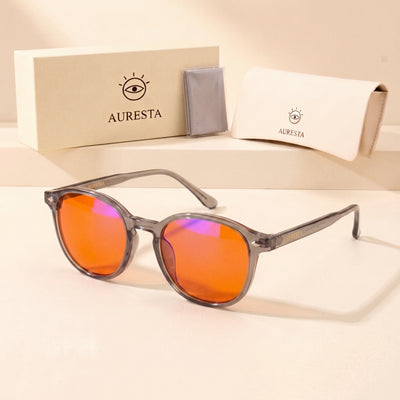
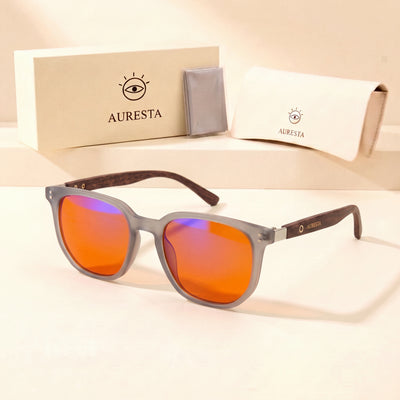
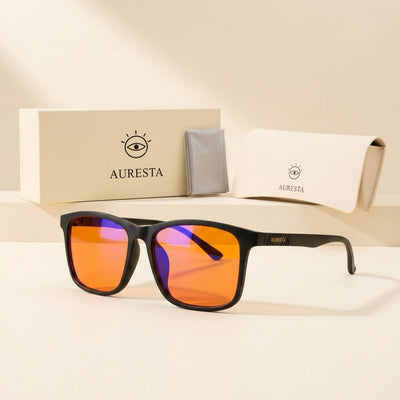
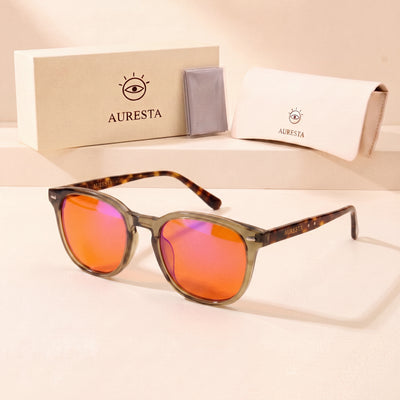
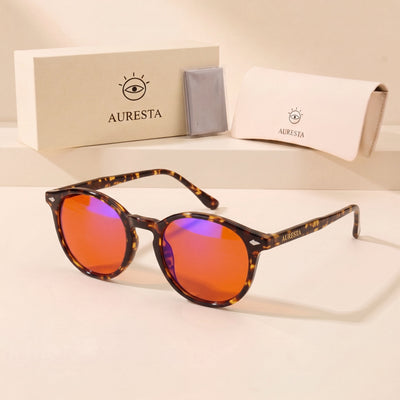
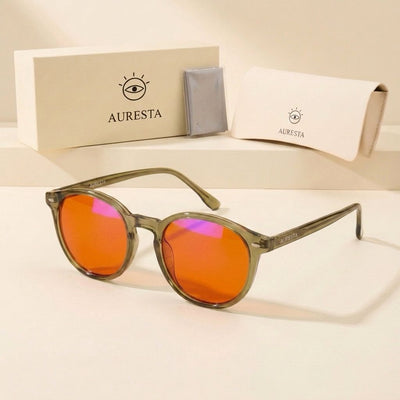
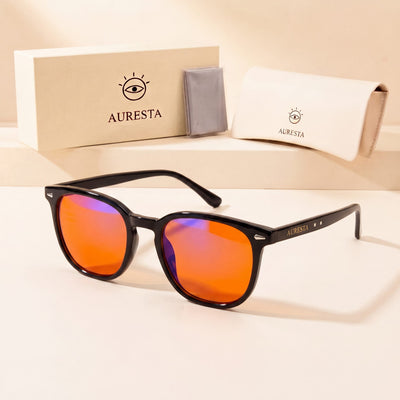
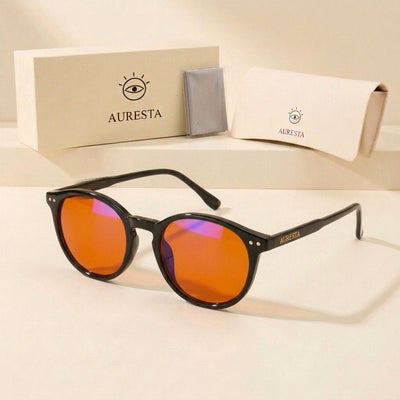
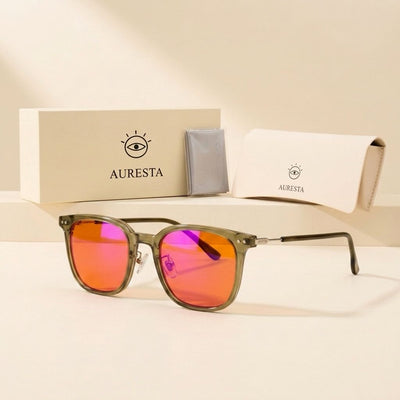
Why Choose Auresta Gaming Glasses?
A gaming session is a long stretch under artificial light in front of a bright panel, and that is the whole design brief. The lens is orange rather than clear, absorbing 99% of blue light across 380–500 nm with 1.01% transmitted and under 0.5% through the 415–455 nm peak — figures measured on a spectrometer to BS EN ISO 12312-1 and printed in full on each product page. Over the top of it sits a nine-layer anti-reflective coating that keeps your own screen, and the lamp behind you, from bouncing back off the glass.
The build is the part you feel at hour six. TR90 memory polymer at about 19 grams, slim straight temple arms shaped to pass under a headset cushion instead of pressing it into the side of your head, and non-prescription plano lenses that sit over contacts. One price across every shape at £49.99, free UK delivery in 2–4 business days, thirty days to send them back with postage covered.
What we will not sell you is an advantage. These do not improve your aim, and the 2023 Cochrane review of 17 randomised trials found no reliable eye-strain benefit from blue-light-filtering lenses — we are not going to pretend otherwise. If you play competitively and read colour cues to win, an orange tint takes information away rather than adding it. Glare, contrast and a screen that stops shouting at you are the real arguments, and they are enough.
Shaped Around a Headset
Slim, straight temple arms are the shape that survives a headset cushion — thick curved arms are what create the pressure point behind your ear. About 19 grams of TR90, which flexes back if you sit on it rather than cracking.
Reflections Off the Glass
Nine layers of anti-reflective coating on both faces, so the RGB behind you and the bright document in front of you stop appearing as ghosts on the lens. On a dark game at midnight that is the difference you notice first.
What They Will Not Do
They will not make you play better, and they are not a fix for a badly lit room. The evidence for blue-light lenses shows no reliable benefit beyond glare and contrast, and this is a category 1 tint you must never drive in — day or night.
Straight answers
What do gaming glasses actually do?
Two things you can verify. The amber tint absorbs blue light in the 400–500 nm range — the part of a monitor’s output that is hardest and coldest — and the nine-layer anti-reflective coating cuts the reflections that bounce off the lens from the screen and the lights behind you. The result is a calmer, higher-contrast picture. What they do not do is improve your aim.
Amber or clear lenses for gaming?
Amber absorbs far more blue light than a clear coated lens, at the cost of a warm cast to the picture. If you play competitively and colour accuracy matters, that cast is a real trade-off — most people stop noticing it within a session. If you are grinding late at night, amber is the one that helps you sleep afterwards.
Will gaming glasses stop headaches after a long session?
Sometimes, but be sceptical of anyone who promises it. The 2023 Cochrane review found no reliable eye-strain benefit from blue-light-filtering lenses. Glare and dry eyes from not blinking are the usual culprits behind a post-session headache; an anti-reflective amber lens helps with the first, and the 20-20-20 rule helps with the second.
Are these comfortable for a six-hour session?
That is what the TR90 build is for. Each frame is about 19 g of memory polymer with slim, straight temple arms designed to pass under a headset cushion rather than fight it.
Can I wear them over a headset?
Yes. The temple arms are slim and straight, which is the shape that survives a gaming headset. Thick, curved arms are what create the pressure point behind your ear.