
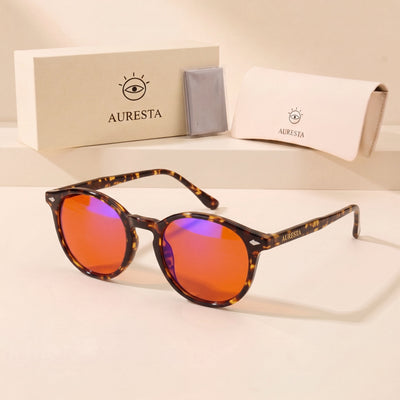
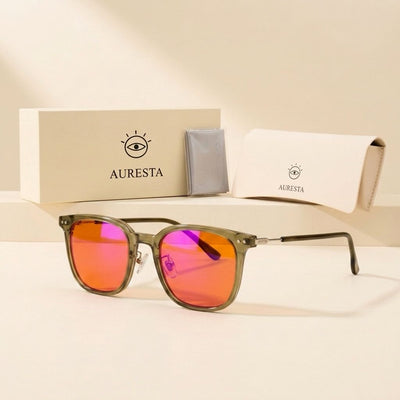
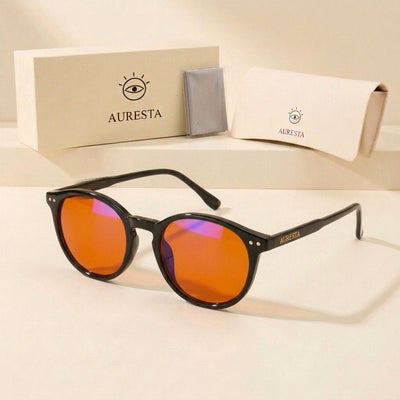
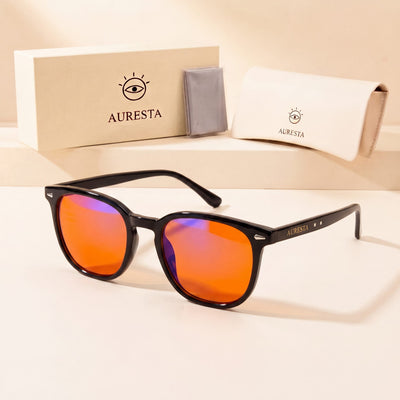
How to Choose Your Auresta Frame
Every frame on this page carries the same lens. Orange rather than clear: 99% of blue light across 380–500 nm filtered, 1.01% transmitted, UV400 with 0.00% transmittance measured at 380, 390 and 400 nm on a spectrometer to BS EN ISO 12312-1. Choosing here means choosing a shape, a colour and a temple — the specification underneath is the same whichever one you pick.
The frames are TR90 memory polymer, not acetate, at about 19 grams each, and every pair is non-prescription plano, so there is no eye test and nothing to configure. One price across the range at £49.99, free UK delivery in 2–4 business days, and thirty days to send a pair back with return postage covered.
What every pair costs you is colour. An orange lens warms whites and pushes blues back — that shift is the filtering, made visible — so take them off for colour-critical work. And do not drive in them, day or night: tested to BS EN ISO 12312-1, the lens scored 0.34 on blue signal light recognition where the standard asks for 0.6 or above.
Start With the Shape
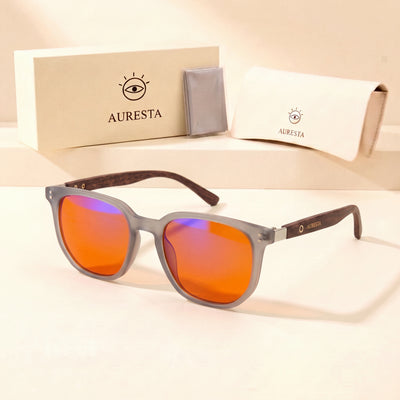
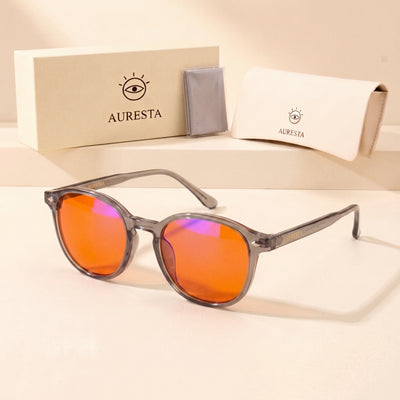
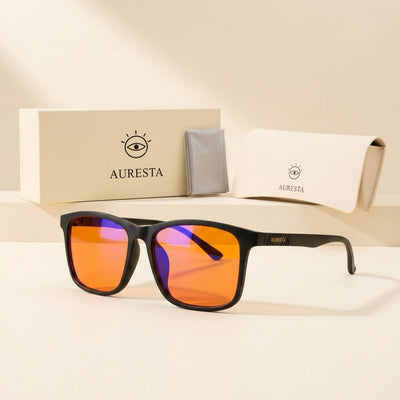
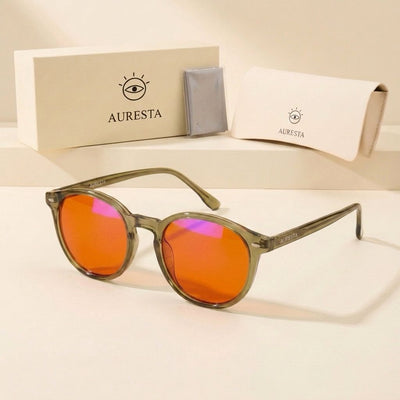
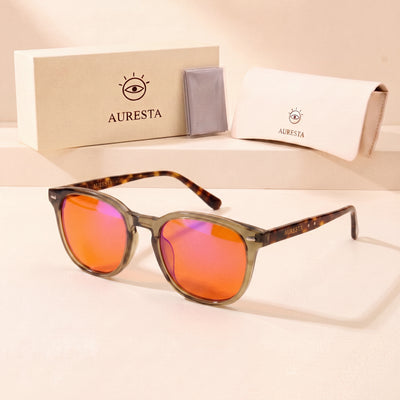
Square — Ember, Olive, Ash — squares up in front of a monitor and suits a rounder face. Round — Raven, Aura, Vesper, Hazel — softens a stronger jaw. Panto — Willow, Rowan — is the eased middle ground that fits the widest range of faces.
Then the Colour
Black and grey stay quiet through a working day; olive, sage and tortoise do not. On the translucent frames the colour runs through the TR90 rather than sitting on top of it, so a scratch shows the same shade underneath.
The Lens Never Changes
Nine-layer anti-reflective coating, UV400, category 1 tint at 47.05% luminous transmittance, under 0.5% transmittance across the 415–455 nm blue peak. Identical in every frame — the Vesper adds a blue-mirror finish on the outer face, which is cosmetic.
Questions About the Range
Which Auresta frame should I buy?
Start with the shape, because the lens is identical across the range. Square frames — Ember, Olive and Ash — sit squarely in front of a monitor. Round frames — Raven, Aura, Vesper and Hazel — read softer against a stronger jaw. The panto shapes, Willow and Rowan, split the difference and suit the widest range of faces. Colour comes second: black and grey stay quiet, while olive, sage and tortoise are a choice you are making out loud.
Do all Auresta glasses use the same lens?
Yes. Every frame carries the same orange lens: 99% of blue light across 380–500 nm filtered, 1.01% transmitted, UV400 at 0.00% transmittance for 380, 390 and 400 nm, category 1 at 47.05% luminous transmittance, under a nine-layer anti-reflective coating. The only variation is cosmetic — the Vesper has a blue-mirror finish on the outside of the lens, which changes what other people see rather than what you do.
How much do Auresta glasses cost, and is UK delivery free?
Every frame on this page is £49.99, whichever shape and colour you choose. UK delivery is free and takes 2–4 business days. Returns run for thirty days from delivery and we cover the return postage, so a pair can sit on your own desk for a month before you decide.
Are these prescription glasses?
No. Every pair ships non-prescription (plano) — no eye test, no lens power, nothing to specify at checkout — so they go over contact lenses or over nothing at all. An optician can glaze your prescription into an Auresta frame, but that replaces the orange lens, which is the part doing the filtering.
How do I know a frame will fit me?
Measure a pair you already own: the eye-bridge-temple numbers are printed inside most temple arms. The Aura is the widest round in the range at 53-19-150, and every product page lists its own measurements in the fit guide. TR90 flexes as well, so a millimetre either way is more forgiving than it would be on a metal frame.
Can I wear them for driving?
No — not at night and not in daylight. Tested to BS EN ISO 12312-1, the lens scored 0.34 on blue signal light recognition where the standard asks for 0.6 or above, which means traffic signals do not read correctly through it. Keep them for screens, desks and walking about.