Auresta Journal
Blue Light Glasses for Sleep: Do They Actually Work?

Blue Light Glasses for Sleep: Evidence-Based Guide to Better Rest
Blue light glasses for sleep are designed to filter the high-energy wavelengths from screens that suppress melatonin production and disrupt your circadian rhythm. These specialized eyewear pieces work by blocking light in the 460–480 nm range—the blue spectrum most responsible for sleep disruption. The evidence is more nuanced than most product pages admit: clear-lens versions have limited effect, while amber-lens glasses with high filtration rates show real promise, particularly for shift workers, frequent travellers, and people with delayed sleep patterns. Here is what the research actually says, and how to choose correctly.

Why Does Blue Light Affect Sleep in the First Place?
Blue light is a short-wavelength, high-energy portion of the visible spectrum emitted by LED monitors, smartphones, and modern overhead lighting. Your eyes contain specialised photoreceptors called intrinsically photosensitive retinal ganglion cells (ipRGCs), which are exquisitely sensitive to wavelengths in the 460–480 nm range — squarely in the blue band.
When these receptors detect blue light in the evening, they signal your suprachiasmatic nucleus — the brain's master clock — to suppress melatonin secretion. Research published in Frontiers in Neurology confirms that evening blue light exposure suppresses melatonin, delays circadian phase, and prolongs sleep onset latency. In practical terms: scrolling your phone or gaming until midnight is not just mentally stimulating — it is chemically telling your brain it is still afternoon.
This biological mechanism is well established. The debate is not whether blue light disrupts sleep — it does. The question is whether wearing filtering glasses is an effective countermeasure.
Do Blue Light Glasses for Sleep Actually Work?
The honest answer is: it depends on your lens type and your personal circumstances.
Research published on PubMed found substantial evidence that blue-blocking glasses reduce sleep onset latency specifically in people with sleep disorders, jet lag, or shift work schedules. For those populations, the intervention is meaningful. However, a randomised controlled trial found blue-blocking glasses did not improve objective sleep measures in healthy adults with no pre-existing sleep difficulties.
A 2023 Cochrane systematic review was candid: it rated the evidence as "very low certainty," meaning results across studies were too inconsistent to draw firm conclusions for the general population. A meta-analysis of 17 studies similarly found no statistically significant improvement in sleep onset latency, total sleep time, or sleep efficiency at the population level.
Why Amber Lenses Outperform Clear Lenses for Blue Light Glasses for Sleep
Lens colour is the critical variable most buyers overlook. Clear or lightly tinted lenses block only a small fraction of blue light. A controlled laboratory study demonstrated that amber and dark-tinted lenses with a high melatonin-difference factor (≥1.0 mDFD) can meaningfully attenuate melatonin suppression — while clear lenses largely cannot. This is precisely why high-quality blue light glasses for sleep use a deep orange tint that filters 99% of blue light across 380–500 nm, not a barely-visible coating on a clear lens.
The distinction is functional, not cosmetic. Amber tints absorb wavelengths in the 400–500 nm range — the exact spectrum most responsible for circadian disruption. Clear filters, regardless of marketing claims, block only a small percentage of incoming blue light, which may be insufficient to produce a measurable effect on melatonin.
Who Benefits Most from Wearing Blue Light Glasses for Sleep?
Blue light glasses for sleep deliver the clearest benefit to three groups.
Shift workers and frequent travellers face chronically misaligned circadian rhythms. Wearing amber-lens glasses during artificial-light exposure in the hours before their intended sleep window gives the melatonin system a fighting chance to respond correctly.
People with delayed sleep phase tendencies — those who habitually fall asleep after midnight — often respond well. A preliminary study in schoolchildren found partial blue-blocking glasses advanced sleep timing and reduced daytime irritability, even without detectable changes in salivary melatonin.
Heavy screen users who spend 8–12 hours daily in front of monitors accumulate significant evening blue light exposure. Gamers, remote workers, developers, and editors are the primary audience for this intervention. If you close a laptop at 11 pm and expect to sleep by midnight, blocking the preceding 90 minutes of blue light exposure gives your melatonin system a meaningful head start.
How Long Should You Wear Blue Light Glasses Before Bed?

Start wearing blue light glasses for sleep approximately 90 minutes to 2 hours before your intended bedtime — this window aligns with the natural rise in melatonin secretion that a healthy evening schedule would produce.
Consistency matters as much as duration. Wearing amber glasses for 90 minutes on some nights and none on others produces inconsistent circadian signalling. Think of it as a daily habit rather than an occasional remedy. If you want to test it, pick a fixed start time about ninety minutes before bed and hold it for two weeks. Occasional use tells you nothing.
Are Blue Light Glasses Worth It — and What Do Health Authorities Say?
The NHS does not currently recommend blue light glasses as a clinical treatment, and the College of Optometrists has said the evidence does not support blue-light-filtering lenses for eye strain, and some optometry bodies have noted the absence of large-scale, high-certainty trials. That is a fair scientific position. However, "not enough evidence to prescribe clinically" is not the same as "proven not to work."
The American Academy of Ophthalmology notes that screens do not cause permanent eye damage, and does not endorse blue-light glasses for eye strain specifically. For sleep, the mechanism is more plausible — blue light's effect on melatonin is not disputed, only whether glasses compensate for it effectively in healthy individuals.
The practical position: if you use screens in the 2 hours before bed and you struggle to fall asleep, a deep orange tint is a cheap thing to try. Know the trade-offs going in: a warm colour cast on everything you look at, and a tint you must not drive in.
Frequently Asked Questions About Blue Light Glasses for Sleep
Can blue light glasses actually help improve sleep quality?
Here is the evidence rather than a promise: trials in shift workers, frequent travellers and people with delayed sleep patterns report shorter sleep onset latency, while population-level meta-analyses find no significant effect in healthy adults and Cochrane calls the overall picture indeterminate. We are not going to tell you which of those you are. Based on peer-reviewed evidence.
High-filtration amber lenses show more consistent results than clear or lightly tinted alternatives. For healthy adults without sleep difficulties, the benefit is less pronounced, and the trade-offs are a warm colour cast, and a tint you must not drive in.
How long should I wear blue light glasses before attempting sleep?
Wearing blue light glasses for sleep roughly 90 minutes before your target bedtime gives your melatonin system time to respond before you attempt sleep.
Consistency over consecutive nights matters more than duration on any single evening. A nightly habit produces better results than occasional use.
Do doctors recommend blue light glasses for sleep?
Amber and orange tints are used in some clinical settings for circadian disruption — but that is a clinician’s decision for a specific patient, not a recommendation anyone can make on your behalf. General practitioners and optometrists typically note that the evidence base is still developing.
No major health authority currently issues a blanket recommendation, but equally, no authority suggests the practice is harmful.
Why do amber lenses work better than clear lenses for blocking sleep-disrupting light?
Amber lenses physically absorb and filter wavelengths in the 400–500 nm range — the spectrum most responsible for melatonin suppression.
Clear blue-light lenses, by contrast, block only a small percentage of incoming blue light, which may be insufficient to produce a measurable circadian effect. Lens colour is not aesthetic here — it is functional.
What Should You Look for in Blue Light Glasses for Sleep?
Not all blue light glasses for sleep are equivalent. Three specifications actually matter.
Filtration rate: Look for lenses that block 95–100% of wavelengths below 500 nm. High-quality options filter 99% of blue light across 380–500 nm — a figure worth asking to see a transmittance table for, measured against EN ISO 12312-1, rather than taking off a box.
Lens colour: Amber or orange tints indicate broad-spectrum filtration. If a lens looks nearly clear, the filtration is minimal regardless of what the marketing says.
Comfort for sustained wear: A pair you will not wear consistently is useless. Lightweight frames — TR90 memory polymer, slim profiles that pass under a headset cup, under 20 grams — make a real difference for anyone gaming or working late. Frames that disappear on your face are frames you will actually wear every night.
What Is the Best Evening Routine to Pair with Blue Light Glasses for Sleep?
For maximum effectiveness, combine blue light glasses for sleep with other evidence-backed sleep hygiene practices. Begin wearing your amber glasses 90–120 minutes before your target bedtime, coinciding with when you typically use screens. Pair this with a consistent sleep schedule—going to bed and waking at the same time daily—and a cool, dark bedroom (around 65–68°F or 18–20°C). Limit caffeine intake after 2 pm and avoid intense exercise within 3 hours of sleep. This integrated approach amplifies the potential benefit of blue light glasses for sleep rather than relying on eyewear alone.
Take Action Tonight

The most effective step is also the simplest: start wearing high-filtration amber glasses 90 minutes before bed tonight, every night, for two weeks. The science on amber lenses and blue light glasses for sleep is more compelling than the general headlines suggest — and for anyone spending serious hours at a screen, the risk-reward calculation is firmly in favour of trying. A 30-day trial period removes the only real barrier to finding out whether this works for you. Wear them, do not just try them on.
Shop the glasses
Orange lenses that filter 99% of blue light across 380–500 nm
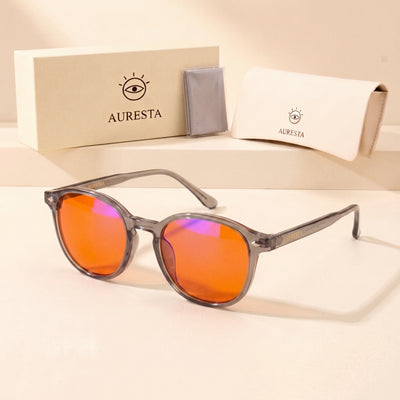 Auresta Aura Orange Lens Blue Light Glasses — Grey Round, Anti-Glare
View
Auresta Aura Orange Lens Blue Light Glasses — Grey Round, Anti-Glare
View
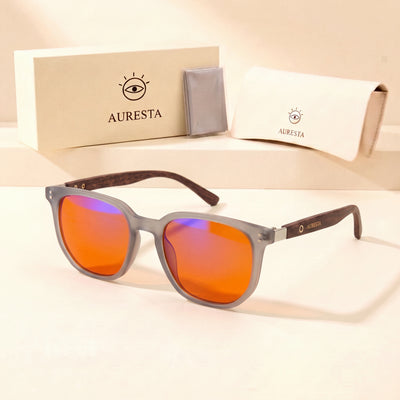 Auresta Ash Orange Lens Blue Light Glasses — Frosted Grey Square, Anti-Glare
View
Auresta Ash Orange Lens Blue Light Glasses — Frosted Grey Square, Anti-Glare
View
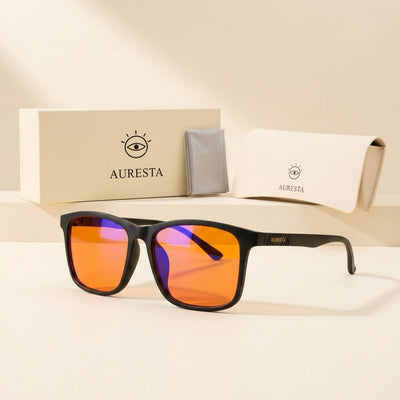 Auresta Ember Orange Lens Blue Light Glasses — Black Square, Anti-Glare
View
Auresta Ember Orange Lens Blue Light Glasses — Black Square, Anti-Glare
View
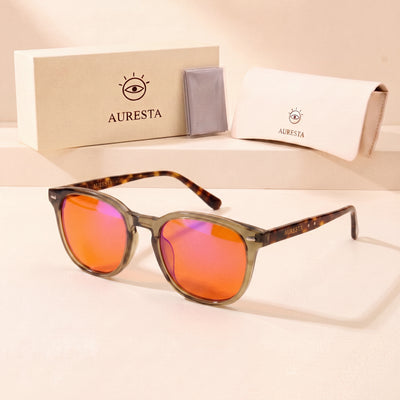 Auresta Willow Orange Lens Blue Light Glasses — Olive Round, Anti-Glare
View
Auresta Willow Orange Lens Blue Light Glasses — Olive Round, Anti-Glare
View