
Auresta Journal
Auresta vs GUNNAR Gaming glasses: Which Should You Choose?
Auresta vs GUNNAR Gaming Glasses: Which Is Right for You?
When gamers and screen-heavy professionals compare blue light glasses, Auresta vs GUNNAR gaming glasses is one of the comparisons that actually comes down to numbers rather than adjectives. Auresta sells one orange lens across eight frames: 99% of blue light filtered across 380–500 nm, in a 19 g TR90 frame, at a flat £49.99. GUNNAR, founded in 2006 in the United States, holds a patented amber lens design (U.S. Patent #9417460) and publishes a figure of 65% of blue light blocked at the 450 nm wavelength for its standard lens. Both use a warm tint. The differences worth your attention are filtration depth, frame material, and what each brand is willing to say out loud.
One thing to get straight before anything else. Our lens figures come from a test report measured on a spectrometer to BS EN ISO 12312-1 — by our lens manufacturer, not by an independent laboratory, and lab-tested to that standard rather than certified to it. The full wavelength-by-wavelength table is published on every product page. Read it before you buy, not after.
What is the core difference between Auresta vs GUNNAR gaming glasses?
Filtration depth. Auresta's orange lens filters 99% of blue light across 380–500 nm; GUNNAR's published figure for its standard lens is 65% at 450 nm.
That gap is the single most important technical distinction, and it is also the thing that costs you something. A lens that stops that much blue light is properly orange, not a faint tint you have to hold up to the light to find. Whites go golden, blues mute, greens soften. If you play competitively and read colour cues to win, that is a real problem and you should buy the lighter tint — ours or anyone's. We would rather tell you than take the money and get the pair back.
GUNNAR's patented lens technology also incorporates a slight 0.25 dioptre magnification, which the brand argues reduces the eye's focusing effort at screen distance. It is a thoughtful engineering choice. Our lenses do not alter focal power at all, which keeps things neutral for people who already wear a prescription or simply want unaltered optics.
What about the frames — TR90 versus polycarbonate?
Both brands use engineering plastics, and neither is a luxury material. Earlier versions of this article described Auresta frames as acetate. That was wrong, and it has been corrected.
Auresta frames are TR90 — a memory polymer, 19 grams, that bends and returns to shape rather than snapping. GUNNAR typically uses injection-moulded polycarbonate or nylon, which is also light and also durable. If you want the tactile density and colour depth of real acetate, neither of us is selling it, and you should expect to pay considerably more elsewhere for it.
What TR90 buys you is survivability. The most common one-star review in this entire category reads "broke in three months". A frame that flexes instead of cracking is a direct answer to that, and it is the reason we chose the material.
How do GUNNAR gaming glasses actually work?
GUNNAR glasses combine an amber-tinted lens with an anti-reflective coating and a slight magnification intended to reduce focusing effort during sustained screen use.
The amber tint absorbs shorter-wavelength blue light — the part of the visible spectrum most associated with glare on a bright display. GUNNAR's own data, cited in a CGMag review, places their standard lens at 65% blocking at 450 nm. Their Intercept model, in its most protective lens variant, can reach up to 98% — though that figure applies to a specific high-blocking lens option rather than the standard product, which is worth knowing before you compare headline numbers.
Worth being even-handed here: some users on communities like r/Gaming4Gamers have noted that GUNNAR's science page leans on marketing citations rather than peer-reviewed work. The same scepticism should be applied to us. The 2023 Cochrane review of 17 randomised trials found blue-light-filtering lenses probably make no difference to eye strain from screens, and the College of Optometrists agrees. Neither brand can honestly promise you relief from tired eyes. Evaluate both of us on published transmittance data, not on adjectives.
Are GUNNAR glasses good for gaming, and how do the two compare in real use?
GUNNAR glasses are genuinely effective for many gamers, with a well-engineered lens that has served screen users since 2006.
What "good" means depends on what you are optimising for. For brand recognition, a large model range, prescription options and North American retail availability, GUNNAR has clear advantages. For maximum filtration, a published wavelength-by-wavelength test table, and a flat £49.99, Auresta is the stronger case.
What about frame comfort during long sessions?
Five, six, eight hours exposes every weakness in a frame. Pressure points on the temples or nose bridge become distracting quickly. Auresta arms are slim and straight, which is the shape that passes under a headset cup instead of pressing into the side of your head; at 19 grams the frame stops registering by about hour two. GUNNAR frames are generally lightweight too and many users find them comfortable. On comfort specifically, there is no dramatic gap between the two — check temple width and arm thickness before buying either.
Is GUNNAR a good glasses brand overall?
Yes. GUNNAR is a well-established eyewear brand with genuine longevity — founded in 2006, among the first to commercialise gaming-specific blue light glasses at scale.
Their patent portfolio demonstrates real R&D investment and their product range is wide. For users in North America, broad retail distribution matters if you want to try before you buy. The brand earned its reputation.
The honest summary: GUNNAR is a good brand. Auresta is a different proposition at a similar price — a deeper tint, a published test report, and a frame material we now describe accurately.
What are the best gaming glasses to buy in terms of value?
The best-value gaming glasses combine published optical data, a frame that survives daily use, and a price that does not require a second thought.
At £49.99 you get an orange lens filtering 99% of blue light across 380–500 nm, a nine-layer anti-reflective coating, UV400 at 0.00% transmittance for 380, 390 and 400 nm, and a 19 g TR90 frame — with the full lens test published on the product page. There is no coating upcharge and no lens upgrade tier. £49.99 is the whole number.
And the limits, in the same breath: this is a Category 1 orange tint that scored 0.34 on blue signal light recognition where BS EN ISO 12312-1 asks for 0.6 or above. It is not suitable for driving or road use, day or night. Take them off for photo editing, video grading and design work too.
You get thirty days to decide. Not thirty days in the box — actually wear them, at your desk, at 10pm, for a week. If the orange isn't for you, send them back for a full refund.
Frequently Asked Questions: Auresta vs GUNNAR Gaming Glasses
Does GUNNAR Optiks really work?
Their amber lens does filter blue light — the published figure is 65% at 450 nm — and the anti-reflective coating reduces glare. Whether the 0.25 dioptre magnification specifically helps varies by individual. On eye strain, the honest answer for every brand in this category is that the 2023 Cochrane review found no reliable benefit. Judge both brands on the glare and contrast difference you can see for yourself.
Why does the Auresta lens filter more blue light than GUNNAR's standard lens?
Because it is a deeper tint. Auresta lenses filter 99% of blue light across 380–500 nm, against GUNNAR's published 65% at 450 nm. More filtration means a more visibly orange lens, and a stronger colour cast. That trade-off is the whole design decision, and it is why we give you thirty days to wear them and change your mind.
Can I wear Auresta or GUNNAR glasses with a gaming headset?
Yes. Auresta arms are slim and straight so they pass under an ear cup rather than pressing into your head. GUNNAR also designs for gaming use and most of their models work well with headsets. If headset comfort is your main concern, check temple width and arm thickness before buying either brand.
Can I drive in either pair?
Not in ours. Tested against BS EN ISO 12312-1, the Auresta lens scored 0.34 on blue signal light recognition where the standard requires 0.6 or above — a direct consequence of how much blue it filters. Day or night, take them off before you pick up the keys. Check GUNNAR's own guidance for their lenses; a lighter tint may be treated differently.
The Final Verdict
It comes down to one pattern. GUNNAR built the category and earns its reputation through longevity, range and retail availability. Auresta entered it with a deeper tint, a published transmittance table, and a price that removes the barrier to trying it. If you play competitively and need colour accuracy, buy the lighter tint. If you spend your evenings on a screen and want the filtering to actually be visible, buy ours — and read the lens test on the product page first.
Shop the glasses
Orange lenses that filter 99% of blue light across 380–500 nm
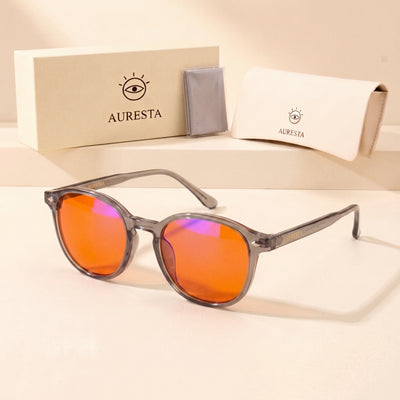 Auresta Aura Orange Lens Blue Light Glasses — Grey Round, Anti-Glare
View
Auresta Aura Orange Lens Blue Light Glasses — Grey Round, Anti-Glare
View
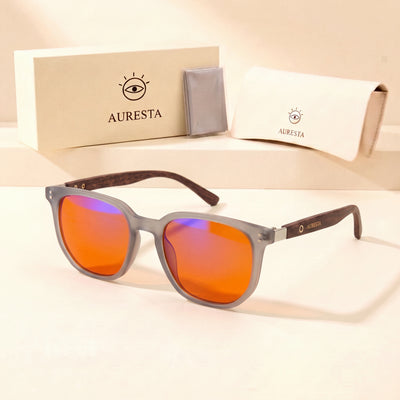 Auresta Ash Orange Lens Blue Light Glasses — Frosted Grey Square, Anti-Glare
View
Auresta Ash Orange Lens Blue Light Glasses — Frosted Grey Square, Anti-Glare
View
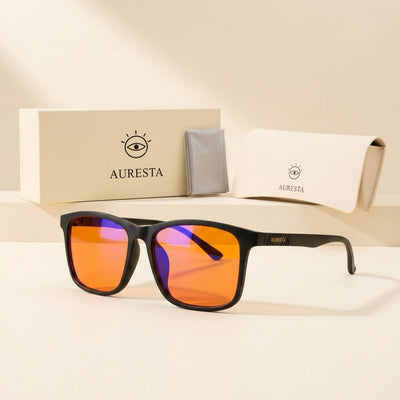 Auresta Ember Orange Lens Blue Light Glasses — Black Square, Anti-Glare
View
Auresta Ember Orange Lens Blue Light Glasses — Black Square, Anti-Glare
View
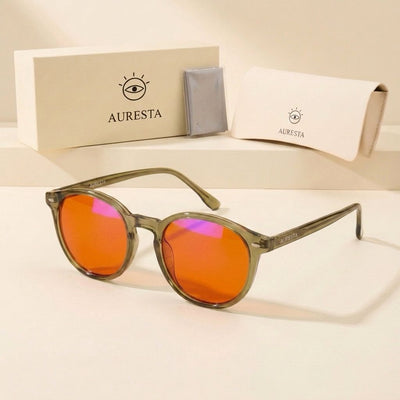 Auresta Vesper Orange Lens Blue Light Glasses — Sage Round, Anti-Glare
View
Auresta Vesper Orange Lens Blue Light Glasses — Sage Round, Anti-Glare
View