Auresta Journal
Blue Light Glasses for Sleep and Gaming: What You Actually Need to Know

Blue light glasses designed for sleep and gaming work by filtering the high-energy wavelengths that screens emit — particularly around 446–479 nm — which are the wavelengths most strongly linked to melatonin suppression. Solutions featuring blue light glasses sleep gaming technology, such as amber-tinted lenses, reduce the glare and screen intensity that contribute to eye strain during long sessions. Put them on for an evening session and the screen goes the colour of a lamp. Whether that does anything for your sleep is a genuinely open question — Cochrane calls the evidence indeterminate, and so do we.
Why Does Blue Light from Gaming Screens Affect Sleep?
Blue light affects sleep because it directly interferes with melatonin production, the hormone your body uses to signal that it's time to rest. Research from Esports Healthcare identifies 479 nm as the peak suppression wavelength — squarely within the range that monitors, phones, and LED-backlit displays emit most intensely.
The practical consequence is straightforward. You finish a two-hour session at midnight, your eyes have been absorbing high-energy blue wavelengths for that entire time, and your brain hasn't received the melatonin cue it needs. That is the mechanism people describe; how much it matters in practice is far less settled than the headlines suggest. Comparative research on screen light exposure shows that gaming screens output a blue spectrum comparable to eBook readers, which have been documented to affect melatonin production in evening use.
For gamers specifically, this creates a real tension. Late-night sessions are common, but they come with a biological cost that accumulates over time — fatigue, reduced focus the next day, and disrupted sleep cycles.
Is It Good to Wear Blue Light Glasses When Playing Video Games?
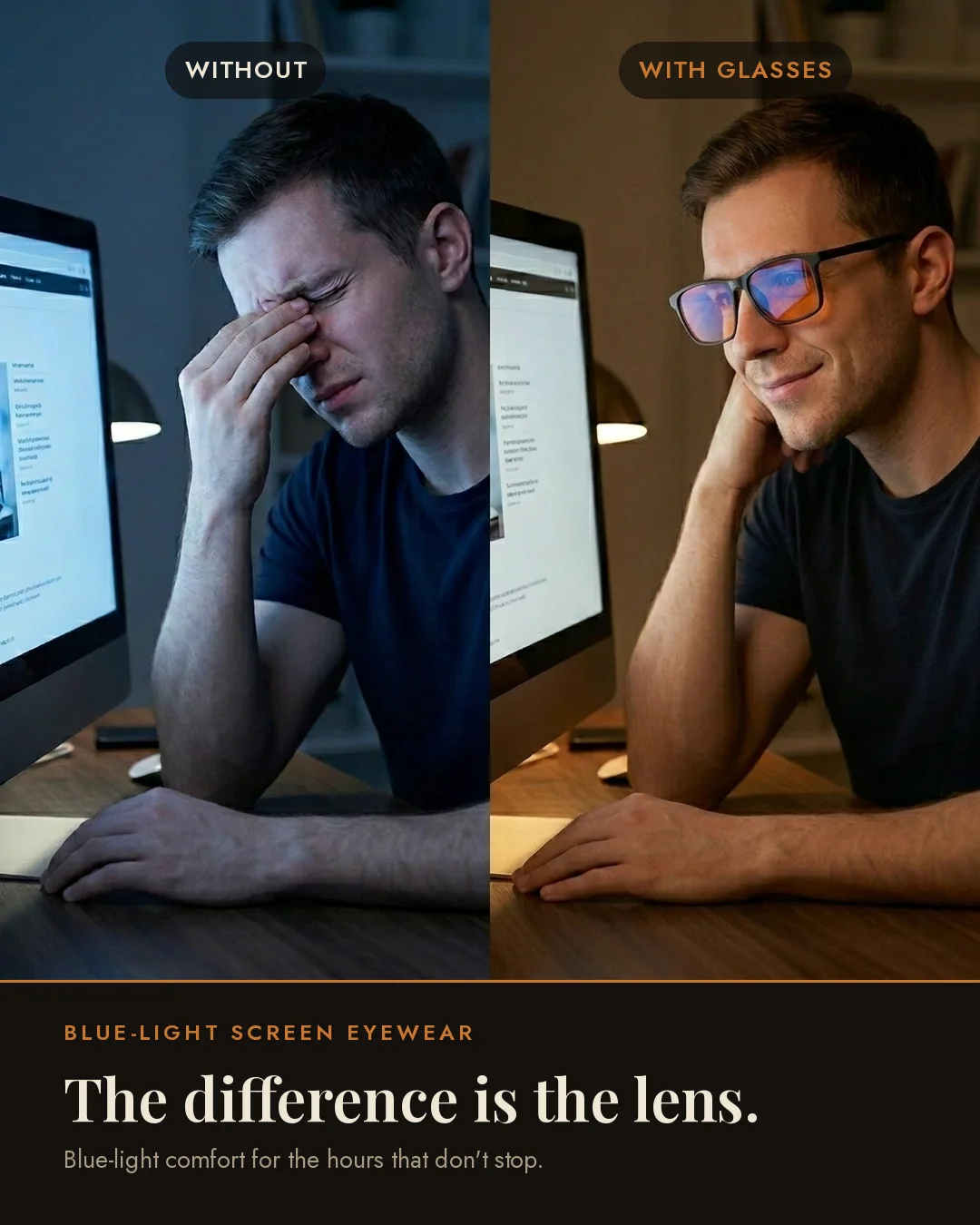
The honest answer is narrower than most brands give you. A deeper tint changes how the screen looks — the reflections drop out and the white stops being a floodlight. On eye strain, the 2023 Cochrane review of 17 randomised trials found filtering lenses probably make no difference, and we are not going to tell you otherwise.
According to optical research cited by Sunski, blue light gaming glasses reduce the intensity of blue light reaching the eye without distorting screen colours — lowering eye tension and headaches during extended sessions. That's especially relevant for competitive or long-form gaming, where sessions routinely run three to five hours.
Our Auresta lenses filter 99% of blue light across 380–500 nm from monitors, phones and LED lighting — lab-tested to BS EN ISO 12312-1 by our lens manufacturer. The amber tint is warm rather than neutral, which means the filtration is deeper than clear or lightly-tinted lenses — and that depth matters most during evening hours when melatonin sensitivity peaks.
One practical note: if you game during daytime hours exclusively, the sleep-related benefit matters less. However, the anti-glare advantage still stands regardless of time of day. Our anti-reflective coating cuts monitor reflections and halo effects, which reduces the micro-strain your eyes accumulate across a long session.
What Does a Deeper Tint Actually Change About an Evening Session?
Gaming glasses help with sleep when they use amber or high-filtration lenses that meaningfully reduce the melatonin-suppressing wavelengths — not just any tinted lens.
There's an important distinction here. Some products marketed as "gaming glasses" prioritise contrast enhancement or colour accuracy over blue light filtration. Some use a light yellow tint that filters perhaps 20–30% of blue light. Research from Regen Optics notes that some filtering lenses block up to 60% of blue light — though what a deeper tint reliably changes is how the screen looks, not how you sleep. Amber lenses, like the ones we use across all Auresta models, sit at the stronger end of that range.
Esports Healthcare confirms that blue light blocking glasses have been shown to reduce melatonin suppression in research contexts — particularly for people who game or work on screens in the hours before bed.
The honest caveat: conflicting evidence exists. Several recent studies found no significant improvement in sleep from blue-blocking lenses in all users, suggesting that individual response varies and that other factors — screen brightness, room lighting, session length — also matter. We'd rather tell you that upfront than oversell a single solution.
What Do Blue Light Glasses Actually Change During a Gaming Session?
What they physically do is absorb high-energy wavelengths and take the reflections off the lens surface. Whether that adds up to less discomfort for you is exactly the question Cochrane could not answer, so judge it on the screen in front of you rather than on our say-so during long gaming sessions.
Long screen sessions are commonly associated with dry, irritated eyes and blurred vision — largely because prolonged focus reduces your blinking rate, which dries the eye surface. The blue light itself is the least well-supported part of that story: the 2023 Cochrane review found filtering lenses probably make no difference to eye strain from screens. Filtering that light source doesn't eliminate the problem entirely, but it reduces one of its primary drivers.
What does anti-glare coating add when wearing blue light glasses sleep gaming gear?
Anti-reflective coatings address a separate but related issue. Reflections from ceiling lights, secondary monitors, or windows create a low-level visual noise that your eyes constantly compensate for — without you consciously noticing. Over three hours, that compensation contributes meaningfully to fatigue.
Our anti-reflective coating on every Auresta lens cuts those reflections at the source. Combined with amber filtration, the result is a screen environment that demands less effort from your eyes to process. The Ember and Olive models are light enough to wear comfortably with headsets for 10+ hours, which is a practical consideration that heavier frames do not always meet.
Is Blue Light Bad for Gaming Performance?
Blue light itself doesn't degrade your in-game reflexes in real time, but the fatigue it accumulates over a long session can reduce focus, contrast sensitivity, and reaction time toward the end of play.
Think of it this way. The first hour of a session, most gamers feel sharp. By hour four, that sharpness has often degraded — and while multiple factors contribute, sustained high-energy light exposure is one of them. As Esports Healthcare notes, the blue light hazard refers to high-energy short wavelengths penetrating deeply into the eye, and the short-term fatigue effect is well established in contexts of sustained screen exposure.
Reducing that input with amber lenses doesn't change your monitor's refresh rate or your connection speed. However, it can sustain sharper, more comfortable vision deeper into a session — which matters in competitive contexts where the fourth hour of play is often when decisions count most.
What Are the Alternatives to Blue Light Glasses for Gamers?
Software filters like Windows Night Light, Nvidia's built-in display settings, and AMD's equivalent tools reduce emitted blue light directly from the display — and they're free. If you're gaming on a budget or want a starting point, these are worth enabling.
However, software filters have limits. They don't address light coming from secondary monitors, overhead LEDs, or phone screens. They also typically shift the entire colour palette toward warm tones, which affects the visual accuracy of games in ways that some players find distracting. Glasses apply filtration to your eye's input rather than to the screen output — meaning you get consistent filtration across every light source in the room, not just the primary display.
Frequently Asked Questions: Blue Light Glasses, Sleep, and Gaming
Can I wear blue light glasses all day, not just for gaming?
Yes — all Auresta models are designed for all-day wear. The amber lenses are most relevant during evening hours when melatonin sensitivity is highest, but the anti-glare and eye-strain benefits apply throughout the day. With a low weight and a profile designed to sit comfortably alongside headsets, extended wear is practical rather than theoretical.
When should I start wearing them before bed to improve sleep?
A general guideline, based on circadian rhythm research, is to reduce blue light exposure at least 60–90 minutes before you intend to sleep. Putting on your Auresta glasses an hour before the end of your session — rather than only right at bedtime — gives your melatonin production more time to recover.
Are amber lenses better than clear blue light glasses for sleep?
Amber lenses filter a broader and deeper range of the melatonin-suppressing spectrum than clear or lightly tinted lenses. If sleep is your primary concern, amber is the stronger choice. Clear lenses offer lighter filtration and are better suited to daytime use where colour accuracy matters more.
Do blue light glasses work if I already use Night Mode on my monitor?
They complement Night Mode rather than duplicate it. Night Mode addresses your monitor's output; glasses address all light entering your eyes, including from other screens and room lighting. Using both together provides more complete coverage than either alone.
Making the Right Choice for Your Setup
The evidence for blue light glasses and sleep in gaming contexts is real but not absolute — individual response varies, and glasses work best as part of a broader approach that includes earlier session cut-offs and dimmer room lighting. What they reliably do is reduce the melatonin-disrupting input during sessions, take the edge off digital eye strain, and cut the glare that builds fatigue across long play.
Our Auresta Ember and Olive models are £49.99 each — one flat price, no coating upcharge, no lens upgrade tier — and come with thirty days to wear them and decide. If you want both a daytime and an evening pair, two glasses bought together come to £89.99, saving an additional £9.99.
For gamers who take late-night sessions seriously, protecting your sleep isn't separate from protecting your performance — it's the same thing.
Shop the glasses
Orange lenses that filter 99% of blue light across 380–500 nm
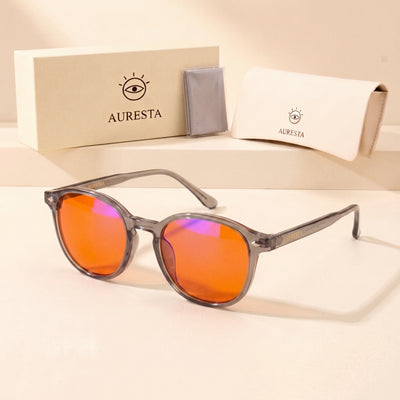 Auresta Aura Orange Lens Blue Light Glasses — Grey Round, Anti-Glare
View
Auresta Aura Orange Lens Blue Light Glasses — Grey Round, Anti-Glare
View
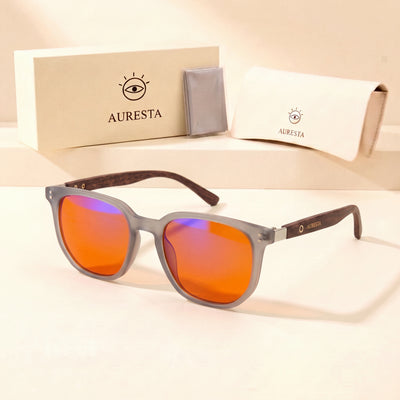 Auresta Ash Orange Lens Blue Light Glasses — Frosted Grey Square, Anti-Glare
View
Auresta Ash Orange Lens Blue Light Glasses — Frosted Grey Square, Anti-Glare
View
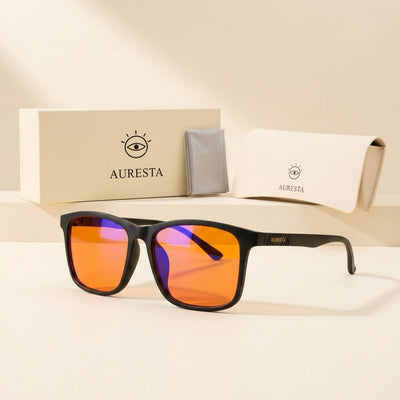 Auresta Ember Orange Lens Blue Light Glasses — Black Square, Anti-Glare
View
Auresta Ember Orange Lens Blue Light Glasses — Black Square, Anti-Glare
View
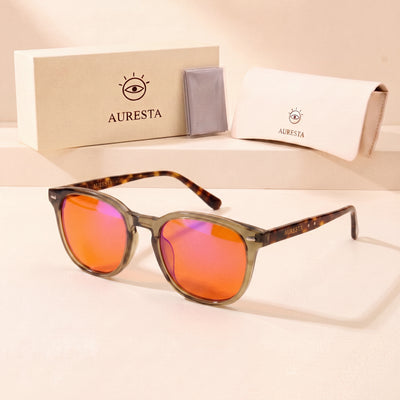 Auresta Willow Orange Lens Blue Light Glasses — Olive Round, Anti-Glare
View
Auresta Willow Orange Lens Blue Light Glasses — Olive Round, Anti-Glare
View