Auresta Journal
Do Blue Light Glasses Help With Headaches? An Honest Answer

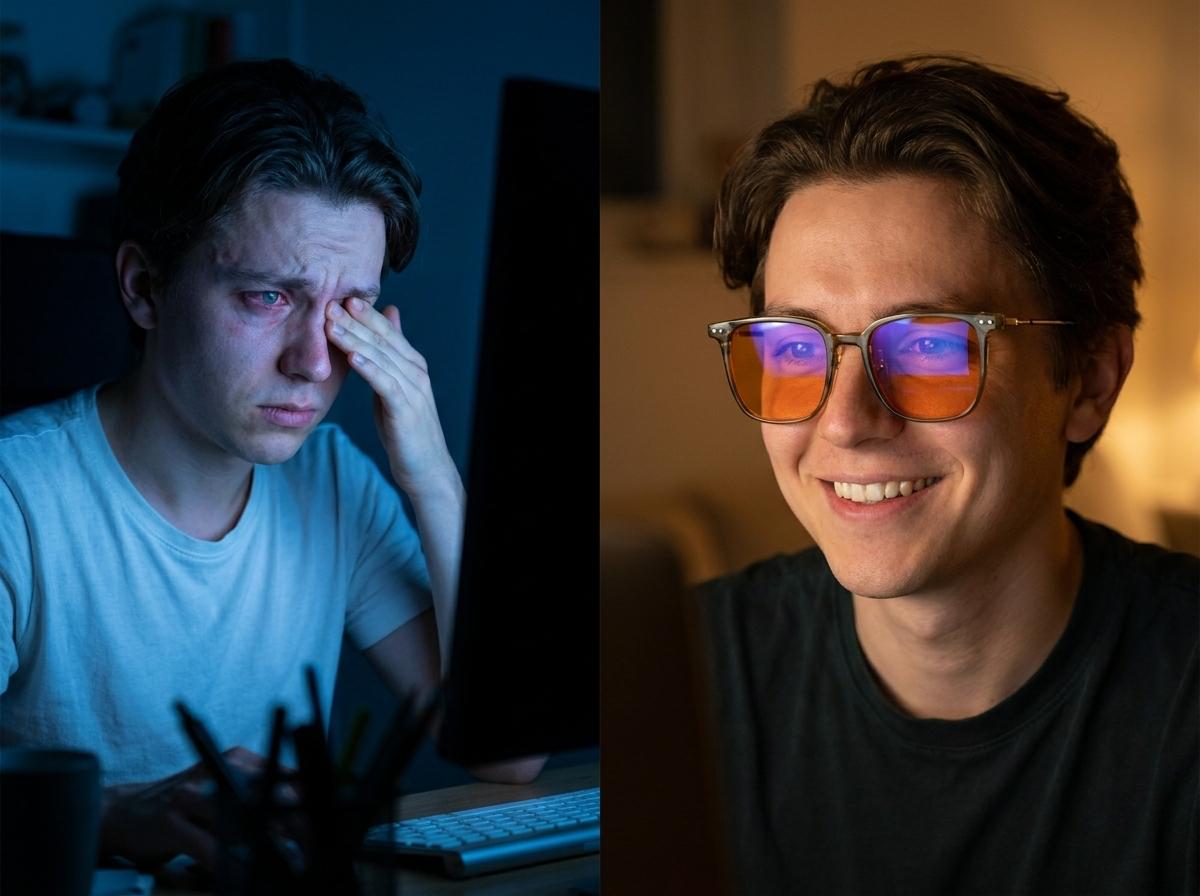
For some people, yes — blue light glasses can help with headaches caused by long screen sessions, mainly by softening glare and the perceived intensity of a bright display. But an honest answer needs the other half too: they are not a headache cure, the research behind them is limited, and they will do nothing for migraines, dehydration headaches or anything unrelated to your screen. This guide explains when they help, when they don't, and what to try first.
Why Do Screens Give You Headaches in the First Place?
The surprising part: blue light itself is rarely the main culprit. According to the American Optometric Association, screen-related discomfort — often called computer vision syndrome — is driven by a cluster of mechanical factors:
- You stop blinking. Blink rate drops from around 15–20 times per minute to as low as 5–7 when you concentrate on a screen. Less blinking means a drier, more irritated eye surface.
- Your focus muscles never rest. Holding focus at a fixed distance for hours fatigues the eye's focusing system — the same way holding any muscle in one position all day would.
- Glare and contrast. A bright screen in a dim room, or reflections from a window behind you, force your eyes to work constantly against competing light levels.
- Posture. A screen that is too high, too low or too close creates neck tension that often reads as a headache.
If you recognise these, our guide to the 5 signs of digital eye strain goes deeper on each one.
What the Research Actually Says
We would rather tell you the truth than sell you a miracle. A 2023 Cochrane systematic review — the most rigorous summary of the evidence to date — found that blue-light filtering lenses may make little or no difference to short-term eye strain from computer use. The American Academy of Ophthalmology is similarly cautious, noting that blue light from screens does not damage your eyes.
On the other side of the ledger, some small pilot studies of people with computer vision syndrome have reported improvements in symptoms including headaches, eye strain and blurred vision when using filtering lenses. The studies are small and the evidence base is thin — which is exactly why any brand claiming their glasses "cure" headaches is overselling.
What amber lenses demonstrably do is physical, not medical: they filter high-energy visible light and reduce glare. Our lenses block 99% of blue light across the 380–500 nm range — lab-tested to BS EN ISO 12312-1. Whether that translates into fewer headaches for you depends on whether glare and brightness are part of your trigger.
Screen Headaches vs Migraines: An Important Distinction
If your headaches are migraines, standard blue light glasses are unlikely to help. Migraine-related light sensitivity is a different mechanism, and the tints studied for it (such as FL-41) are specialised medical products. The same goes for headaches from dehydration, sinus pressure, eye conditions that need correction, or anything that persists when you are away from screens.
A simple test: do your headaches build during screen time and ease when you take a day off screens? That pattern points to screen habits — fixable. Headaches that arrive regardless of screen use deserve a visit to an optometrist or GP, not a pair of glasses.
What Actually Helps — Do These First
Before spending anything, these habits have better evidence behind them than any lens:
- The 20-20-20 rule. Every 20 minutes, look at something 20 feet away for 20 seconds. It rests your focusing muscles and restarts your blinking.
- Match your screen to the room. Your display should not be dramatically brighter than the space around it, especially at night.
- Kill reflections. Position your screen so windows and lamps are not mirrored in it.
- Set the distance. Roughly an arm's length away, with the top of the screen at or slightly below eye level.
- Take real breaks. Stand up, hydrate, look out of a window. Your eyes recover fast when you let them.
Where Amber Lenses Honestly Fit
If you have fixed the habits above and bright screens still feel harsh — that is where a warm amber tint earns its place. Wearers most often describe the difference as the screen feeling "quieter": less glare, less of that scratchy end-of-day feeling. And in the evening there is a second, better-documented benefit: filtering blue wavelengths in the hours before bed supports your natural melatonin cycle, which we cover in detail in our guide to blue light glasses for sleep.
One honest limit, always: our amber lenses are Category 1 tinted and are not suitable for driving or road use.
Frequently Asked Questions
Can blue light glasses cure migraines?
No. Migraines involve different mechanisms than screen-related eye strain, and standard blue light glasses are not a treatment for them. If you experience migraines, speak to a GP or optometrist — specialised tints exist, but they are medical products prescribed for light sensitivity, not consumer eyewear.
How long does it take to notice a difference?
The glare-softening effect of an amber lens is immediate. Whether that reduces your headaches takes longer to judge — give it one to two weeks of consistent use during screen sessions. If headaches persist unchanged, the cause is likely something other than screen glare, and an eye test is the sensible next step.
When should I see a professional about screen headaches?
If headaches are frequent, severe, persist on screen-free days, or come with vision changes, book an eye test. Uncorrected prescription problems are one of the most common — and most fixable — causes of screen headaches, and no filtering lens can substitute for correction you actually need.
Do I still need blue light glasses if I use Night Shift or dark mode?
Software filters warm your screen's output in the evening, and they genuinely help — we recommend using them. A physical lens works on all light sources at once (multiple monitors, TV, overhead LED lighting) and does not depend on every device being configured, so many people use both together.
The Bottom Line
Blue light glasses can take the harsh edge off long screen sessions, and for people whose headaches are glare-driven, that can genuinely matter. They are not a medical treatment, and we will never pretend otherwise. Fix your setup and habits first; if bright screens still wear you down, an amber lens is a comfortable, lab-tested tool — you can read exactly what our lenses do and don't do in the Auresta FAQ.
Shop the glasses
Orange lenses that filter 99% of blue light across 380–500 nm
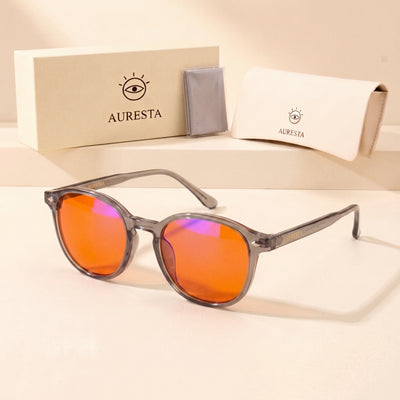 Auresta Aura Orange Lens Blue Light Glasses — Grey Round, Anti-Glare
View
Auresta Aura Orange Lens Blue Light Glasses — Grey Round, Anti-Glare
View
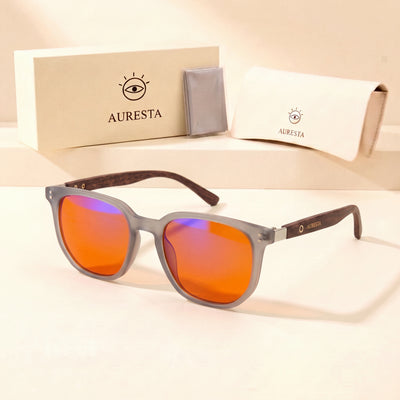 Auresta Ash Orange Lens Blue Light Glasses — Frosted Grey Square, Anti-Glare
View
Auresta Ash Orange Lens Blue Light Glasses — Frosted Grey Square, Anti-Glare
View
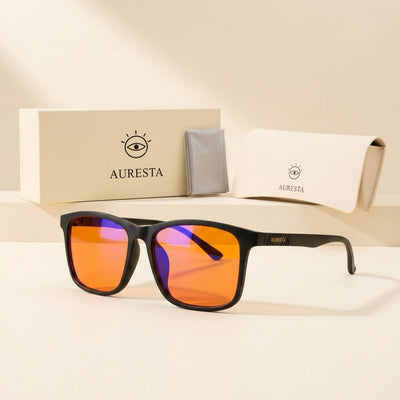 Auresta Ember Orange Lens Blue Light Glasses — Black Square, Anti-Glare
View
Auresta Ember Orange Lens Blue Light Glasses — Black Square, Anti-Glare
View
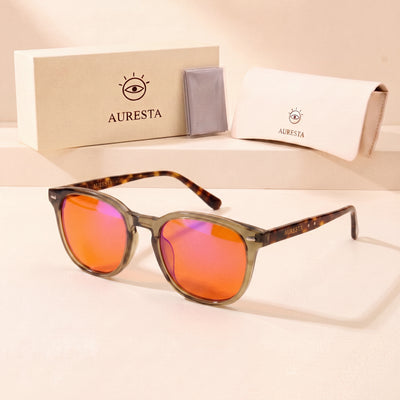 Auresta Willow Orange Lens Blue Light Glasses — Olive Round, Anti-Glare
View
Auresta Willow Orange Lens Blue Light Glasses — Olive Round, Anti-Glare
View