Auresta Journal
Auresta Glasses Frames Comparison: Which Model Is Right for You?

When comparing Auresta glasses frames, you are comparing eight shapes wrapped around one identical lens. Ember, Olive, Aura, Vesper, Raven, Hazel, Ash and Willow all use the same orange blue-light lens and the same 19 g TR90 frame material. An Auresta glasses frames comparison is therefore a question about shape, colour and face geometry — not about optical performance, because on that front there is nothing to choose between them.
Every model carries identical optics: an orange lens that filters 99% of blue light across 380–500 nm, a nine-layer anti-reflective coating, and UV400 — 0.00% transmittance at 380, 390 and 400 nm. Those figures come from a lens test report measured to BS EN ISO 12312-1 by our lens manufacturer. Note the wording carefully: lab-tested to that standard, by the manufacturer, not certified to it and not by an independent laboratory. The same report is the reason we say, on every page, that these are not suitable for driving or road use.

What material are Auresta frames made from?
TR90 — a memory polymer, not acetate. Nineteen grams, and it bends instead of breaking.
We used to describe these frames as acetate. That was wrong, and this article has been corrected. TR90 is a thermoplastic used across sports and performance eyewear precisely because it flexes and returns to shape. Sit on a pair of acetate frames and you hear a crack; sit on these and they come back. It is not a luxury material and we are not going to pretend it is one — what it is, is the material that survives being shoved in a bag every day for a year.
The practical consequences you can check yourself: 19 grams on the bridge, slim straight temple arms that pass under a headset cup rather than pressing into the side of your head, and a frame that tolerates being sat on. The most common one-star complaint in this whole category is "broke in three months". TR90 is our answer to it.
How does the Ember model compare to the Olive?
Ember and Olive are the two plainest frames in the range — identical weight and optics, opposite aesthetics.
Ember is a matte black square TR90 frame. The squared silhouette is angular and structured, which tends to complement rounder or oval face shapes by adding definition. Matte black is the most versatile colourway in eyewear — it goes from a midnight gaming session to a noon video call without looking out of place. Its low-profile build sits flush under gaming headsets.
Olive leans more expressive. The translucent olive-green TR90 lets light through the material, which reads as contemporary without being loud. The translucent green works particularly well for warmer skin tones and pairs naturally with casual or creative work environments.
Both are £49.99. That is the whole number — there is no coating upcharge and no lens upgrade tier. If you want both, the two-pair bundle brings the total to £89.99.
What about Aura, Vesper, Raven, Hazel, Ash and Willow?
Six more shapes, same lens, same 19 g TR90 build.
Aura is a smoky translucent grey round frame in a 53-19-150 fit with a gold AURESTA temple detail — clean, minimal and deliberately understated. Grey works as a neutral across almost every skin tone.
Vesper is a translucent sage round frame, with a cool blue-mirror finish over the lens. Round frames soften angular jaw lines. The sage is quieter than Olive — more muted, slightly grey-green — for people who want a colour accent rather than a statement.
Raven is glossy black and round, with slim metal temples and a gold AURESTA wordmark. A vintage-leaning silhouette; the lightest-looking frame in the range without being the lightest to wear, because they all weigh the same.
Hazel is classic round tortoise. Tortoiseshell has stayed an eyewear staple for a century because it reads warm rather than corporate — this is the pair that looks least like office equipment.
Ash is the only frame that mixes materials: a matte frosted grey square front with dark wood-finish temples on polished silver hinges. The frost diffuses light rather than reflecting it, and skips the fingerprint-polishing ritual a gloss finish demands.
Willow layers two colours — a translucent olive round panto front with warm tortoiseshell temples. The olive reads green in daylight and closer to smoke under a lamp.
Which frame shape suits your face geometry?
Frame shape and face geometry interact in ways that genuinely affect how glasses look and feel over long wear sessions.
Square frames like Ember and Ash add angular definition. They work well with oval, round or heart-shaped faces — the structured edges balance softer facial curves. Round frames like Vesper, Raven, Hazel and Willow do the opposite: they soften strong jaw lines and angular faces, particularly square or oblong face shapes.
Fit is measured by lens width, bridge width and temple length in millimetres — typically written as three figures, such as 53-19-150. Ray-Ban's sizing guide is a useful general reference for how those measurements translate to an actual face. Auresta frames use a moulded TR90 bridge, which spreads pressure across a wider surface than metal nose pads — generally more comfortable across a full day.
In short: Ember for structure and versatility, Olive and Willow for colour, Vesper and Aura for understatement, Raven for a vintage line, Hazel for warmth, Ash for texture.
FAQ: Common Questions About Auresta Glasses Frames
What are Auresta frames made of?
TR90 — a flexible memory polymer used in sports and performance eyewear. Nineteen grams, and it bends rather than snapping. It is not acetate, and earlier versions of this page described it incorrectly.
Does the frame material change how much blue light is filtered?
No. Filtering happens in the lens, not the frame, and every Auresta frame carries the identical orange lens: 99% of blue light across 380–500 nm filtered, nine-layer anti-reflective coating, UV400 at 0.00% transmittance for 380, 390 and 400 nm. Choosing between frames is purely a question of shape and colour.
What frame colour brightens the face?
Warmer, lighter colourways — translucent frames, tortoiseshell and green tones — tend to brighten the face and are widely regarded in eyewear styling as the more flattering choices. Olive, Vesper, Hazel and Willow all sit in that territory.
Do orange lenses actually work better than clear blue light lenses?
For filtering blue light, yes, and it is not close — though be careful what you take that to mean. A 2023 Cochrane review found that blue-light-filtering lenses probably make no difference to eye strain from screens, and the College of Optometrists says the same. We do not claim otherwise. What an orange lens does differently from a clear one is physical: it absorbs blue light across 380–500 nm rather than reflecting a small share of it, which raises contrast and takes the reflections and the harsh white off a bright monitor. The visible cost is a warm colour cast. Every Auresta lens is orange — not clear.
Which Auresta frame should you choose?
The right frame comes down to three things: face shape, personal style, and how visible you want the colour to be.
Choose Ember for maximum versatility. Olive or Willow for a personality-forward colourway. Vesper or Aura if you want the quietest thing in the range. Raven for a vintage round line, Hazel for warm tortoiseshell, Ash for the frosted-and-wood combination.
All eight are £49.99 at auresta.co.uk, with free UK shipping, 2–4 business day delivery, and thirty days to wear them and decide. Not thirty days in the box — actually wear them, at your desk, at 10pm, for a week. If the orange isn't for you, send them back for a full refund. The two-pair bundle at £89.99 makes the decision easier if you are caught between two.
Shop the glasses
Orange lenses that filter 99% of blue light across 380–500 nm
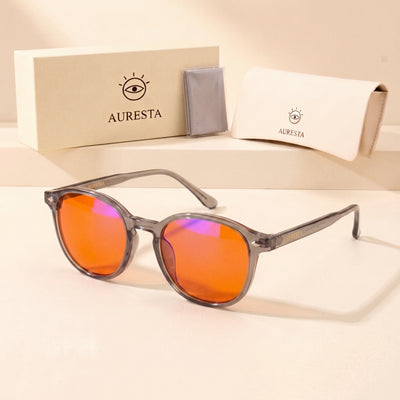 Auresta Aura Orange Lens Blue Light Glasses — Grey Round, Anti-Glare
View
Auresta Aura Orange Lens Blue Light Glasses — Grey Round, Anti-Glare
View
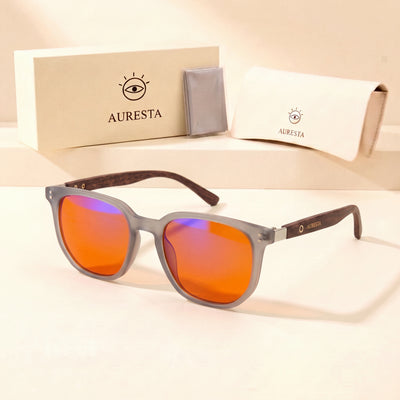 Auresta Ash Orange Lens Blue Light Glasses — Frosted Grey Square, Anti-Glare
View
Auresta Ash Orange Lens Blue Light Glasses — Frosted Grey Square, Anti-Glare
View
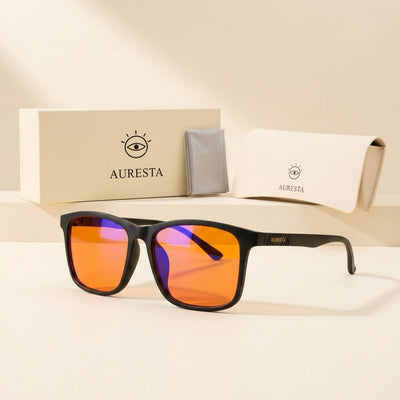 Auresta Ember Orange Lens Blue Light Glasses — Black Square, Anti-Glare
View
Auresta Ember Orange Lens Blue Light Glasses — Black Square, Anti-Glare
View
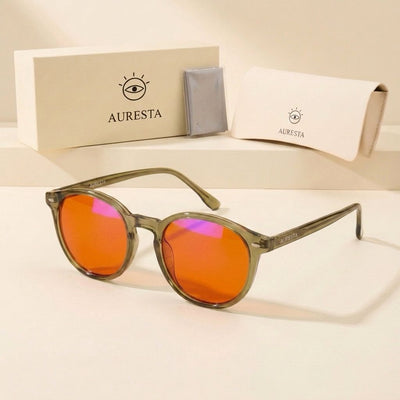 Auresta Vesper Orange Lens Blue Light Glasses — Sage Round, Anti-Glare
View
Auresta Vesper Orange Lens Blue Light Glasses — Sage Round, Anti-Glare
View